
The Nigeria Tax Act 2025 is the biggest shake-up to personal income tax in over a decade. For the 9-to-5 worker, it brings a genuinely surprising number of reliefs, but only if you know to claim them.
Every January, your employer updates your PAYE deductions and the numbers change on your payslip. Most employees accept this quietly, assuming the government has done the math correctly on their behalf. Some of the time, it has. But the Nigeria Tax Act 2025, which took effect on 1 January 2026, introduced a new set of reliefs and deductions that reduce the income you are taxed on. If your HR or payroll team has not applied them all, you could be overpaying.
Here is every relief a salaried Nigerian employee can legitimately claim, and exactly how each one works.
A critical change you need to know first
The old Consolidated Relief Allowance (CRA), the 20% plus ₦200,000 formula most employees recognize from their payslips, is gone. Effective January 2026, it has been replaced with a new Rent Relief, and the tax-free income threshold has been raised significantly. Everything below is under the new rules.
The New Tax Bands
Before we get to reliefs, here is the updated progressive rate structure your chargeable income is taxed against after deductions:
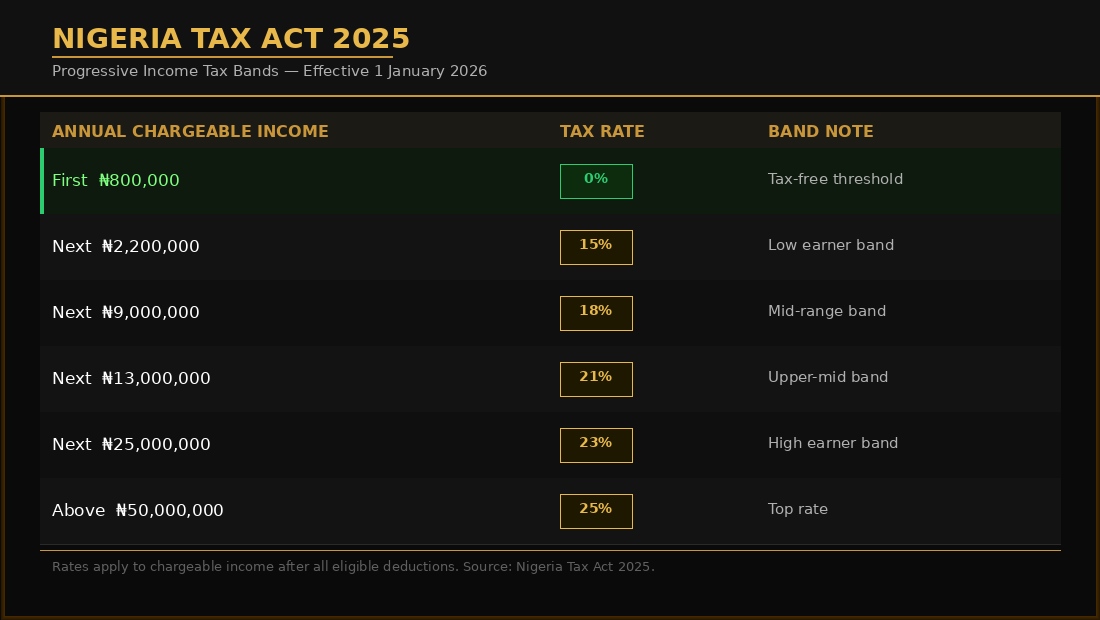
These rates apply after you have subtracted all eligible deductions. The lower your chargeable income, the more of it falls in the 0% and 15% bands. This is why knowing and claiming every available deduction matters.
Relief 1: The ₦800,000 Tax-Free Threshold
The first ₦800,000 of your annual chargeable income, calculated after all other deductions, is taxed at 0%. Separately, anyone earning the national minimum wage of ₦70,000 per month or less is completely exempt from PAYE entirely, with no filing required and no deductions made.
For everyone else, the 0% band functions as a built-in floor that shelters the bottom slice of what you earn. This is the single biggest structural change from the old system, and it benefits every salaried worker in Nigeria regardless of income level.
Relief 2: Rent Relief at 20% of Your Actual Rent, Capped at ₦500,000
This is the direct replacement for the old CRA. Under Section 30 of the Nigeria Tax Act 2025, you may deduct 20% of the annual rent you actually pay for your home, with the total deduction capped at ₦500,000 per year.
If you pay ₦1,200,000 in annual rent, your deduction is ₦240,000. If you pay ₦3,000,000 in rent, you still only deduct ₦500,000 because that is the legal ceiling.
You must have documentary evidence of rent payment, specifically a tenancy agreement and receipts. If your employer provides your accommodation, this relief does not apply to you. In that case, the taxable value of your housing benefit is capped at 20% of your gross income, which is its own form of protection for employees receiving accommodation as a workplace perk.
Relief 3: Pension Contributions at 8% of Your Pensionable Emoluments
Your mandatory employee pension contribution of 8% of your basic salary, housing allowance, and transport allowance combined is fully deductible from taxable income. This has always been the case, and the new law retains it.
What many employees do not know is that Additional Voluntary Contributions beyond the statutory 8% are also deductible. If you contribute more than the required amount to your Retirement Savings Account, that excess also reduces your chargeable income. For any worker looking to legally shelter more income, increasing pension contributions is one of the most straightforward tools available. Pension funds and their investment income remain completely tax-exempt under the new law.
Relief 4: National Housing Fund Contributions at 2.5% of Basic Salary
If you are a formal sector employee earning ₦3,000 or more monthly, you contribute 2.5% of your basic salary to the Federal Mortgage Bank's National Housing Fund. Under Section 30(2)(a)(i) of the NTA 2025, this contribution is fully deductible from your taxable income.
Beyond the tax advantage, NHF contributions also make you eligible for low-interest mortgage loans from the Federal Mortgage Bank of Nigeria. This deduction therefore serves two purposes: it reduces what you are taxed on today and it builds your eligibility for subsidised housing finance in the future.
Note that NHF participation is not always mandatory for private sector employees. Check with your HR team whether your employer participates in the scheme and whether contributions are being deducted on your behalf.
Relief 5: National Health Insurance Scheme Contributions
Under Section 30(2)(a)(ii), your NHIS/NHIA contributions are deductible from taxable income. The standard rate for formal sector employees is 5% of basic salary, though this can vary by employer scheme.
You will need proof of payment, such as contribution receipts or records from your HMO, to back this claim. Private sector employees often operate under Health Maintenance Organisations rather than NHIS directly. The deductibility rules are the same in principle, but confirm with your payroll team whether your specific scheme qualifies under the new law. The NTA 2025 specifically requires documentary evidence for this deduction to be applied.
Relief 6: Life Insurance Premiums
Section 30(2)(a)(v) of the NTA 2025 allows you to deduct premiums paid on life insurance or deferred annuity contracts covering your own life or your spouse's life. The National Insurance Commission (NAICOM) regulates licensed insurers in Nigeria.
The deduction is limited to the actual premium paid in the year preceding the year of assessment. There is no standard ceiling and you deduct what you actually paid, so keep your premium payment receipts and your policy documents in order.
One important condition: if you withdraw from a deferred annuity product before five years have passed from when you first paid the premium, the amount withdrawn becomes taxable income at that point. The five-year rule is worth knowing before making any early withdrawal decisions.
Relief 7: Mortgage Interest on Your Owner-Occupied Home
If you took out a mortgage or loan to buy or build your primary residence, the interest component of your repayments is deductible from employment income. This covers interest only and not capital repayment, so the distinction matters when calculating your eligible deduction.
You will need your mortgage statement from your bank or finance company showing the interest charged for the year. This relief applies specifically to an owner-occupied property and does not cover a rental property or a second home. For mortgage options available to Nigerian workers, you can explore products offered by the Federal Mortgage Bank of Nigeria. Ask your lender for an annual interest statement if one is not provided to you automatically.
Relief 8: Compensation for Job Loss up to ₦50 Million
Under the new law, compensation for loss of employment is tax-exempt up to ₦50 million, which is five times the previous threshold of ₦10 million. This covers redundancy pay, severance packages, and compensation for injury or wrongful termination.
For most workers this will never come into play, but for those navigating corporate restructuring or involuntary exits it is an important protection to know about. Any amount received beyond ₦50 million becomes taxable income in the normal way.
Relief 9: Work Tools and Specialized Equipment
Section 14(3) of the NTA 2025 expands tax exemptions to include the value of work tools and specialised equipment necessary for an employee's role. If your employer provides you with laptops, protective gear, technical instruments, or other specialised work tools, the taxable benefit-in-kind value of those items is exempt.
This particularly benefits workers in technical, engineering, and industrial roles where high-value equipment is a normal part of the job. Employees in these sectors should ensure their payroll team is applying the exemption correctly.
What Changed from the Old System
The biggest practical shift is the removal of the CRA. Under the old Personal Income Tax Act, almost every formal sector employee benefited from the 20% gross income plus ₦200,000 formula regardless of their actual expenses. The new rent relief only reduces your taxable income if you actually pay rent and can document it.
For homeowners without a mortgage, the old CRA system was more generous. For renters, who make up the majority of Nigerian urban workers, the new system better reflects real living costs, but only if the paperwork is in place.
One change that catches people off guard is that gratuity is now taxable under the NTA 2025. Pension and retirement benefits paid under the Pension Reform Act remain fully tax-exempt, but gratuity paid outside that framework is no longer sheltered. Long-serving employees expecting large lump-sum gratuity payments should factor this into their financial planning.
The Most Important Practical Step
Check your payslip. From January 2026, your PAYE calculation should reflect the new rent relief, updated pension deductions, and the new tax bands. If your payroll team is still running the old CRA formula, your deductions are wrong.
If you pay rent, ensure your tenancy agreement and receipts are accessible. If you contribute to NHIA or NHF, ensure those contributions are on record. You can also verify your tax obligations directly with the Nigeria Revenue Service (formerly FIRS). The NTA 2025 does not reward assumptions. It rewards documentation.
Disclaimer: This article is for informational purposes only and does not constitute tax or legal advice. Consult a qualified tax professional for guidance specific to your circumstances.