BUSINESS & STRATEGY
Question: Why do all Item 7 Restaurants have huge buildings but no visible entrances, and there's not much of an option for sit-ins? Especially for such a two-option menu, what's all that space for?
Short answer: It may look like a half-finished operation or a waste of space, but what it actually functions as is one of the most deliberate business models in existence.
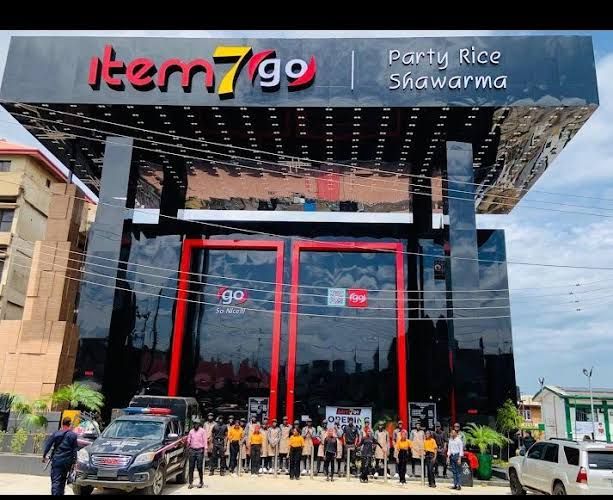
You have seen the place. The building is enormous, the interior is sparse, and the menu has only two items on it. Rice. Shawarma. There are no starters. No cocktails. Sometimes there is no proper entrance, with patrons only seeing a gap in the fence and a table where someone takes your money. Your initial reaction might be concern.
"This place must be struggling," you might think, observing the minimalist approach and limited offerings. "Surely, a business needs more variety and a more inviting atmosphere to thrive."
However, this assumption, though understandable, couldn't be further from the truth. These operations are far from struggling; in fact, many of them are highly profitable, generating substantial daily revenue. The secret to their success lies in a highly optimized and strategically sound business structure, one with a recognized name in operational management: the flow shop.
• • •
What a Flow Shop Actually Is
A flow shop is a variant of a production model called a job shop. In a regular restaurant — your full-service, multi-course, build-your-own-plate kind of place — the kitchen is a job shop. Different orders go through different processes in different sequences. A customer who orders pepper soup and fried plantain requires a completely different kitchen path from one who wants pounded yam and egusi. Each order is essentially its own production run. This flexibility is the point. It is also the source of inefficiency.
A flow shop inverts this entirely. Instead of building the kitchen around infinite variety, it is built around one or two outputs and optimized relentlessly for the speed and volume of those specific outputs. Every station in the kitchen exists to serve the one product. Every process is sequenced, practiced, and refined. Nothing is improvised. The result is that what a full-service kitchen might produce in four hours, a well-run flow shop can produce in forty minutes and at a lower cost per unit.
The Item 7 spot is a flow shop. The jollof rice is not one of the fifteen dishes it makes. It is the entire production system, organized around that dish and nothing else.
• • •
Why the Building Is Bare, and the Menu Is Short
What looks like an unfinished building is actually a design decision. In a flow shop, your inputs go into production efficiency, not ambience. Tables, chairs, lighting, decor — these cost money and create maintenance overhead without increasing throughput. The customer is there to eat fast and leave. The faster they eat and leave, the faster the table turns, and the more revenue the seat generates per hour.