
    Your Team Is Too Quiet. That's Not a Good Sign.

    Is your team too quiet? A silent team isn't always a happy team. Discover why a lack of dissent can signal deeper issues and stifle true innovation.

    Jump to
    Your Team Is Too Quiet. That's Not a Good Sign.
    Illustration · CareerBuddy

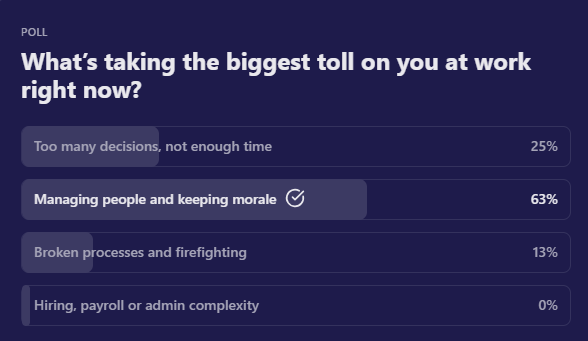
    Last week, we ran a poll. We asked the WorkShift community — founders, managers, operators, HR leads — what's taking the biggest toll on them at work right now. Sixty-three percent said managing people and keeping morale. Not broken processes, not hiring complexity. "Managing People and keeping morale" won, by a landslide.
    Your Team Is Too Quiet. That's Not a Good Sign.

    Here's what that tells me: a lot of leaders are working very hard to keep their teams happy. And some of them are succeeding; on paper. The vibes are good. People show up. And it seems nobody is complaining.

    That last part should worry you.

    The team that never pushes back

    There's a version of "good morale" that is genuinely good. People are energised, they believe in what they're building, they trust each other enough to have real disagreements and move past them. That team is rare and worth protecting.

    Then there's the other version. Meetings where everyone nods. Feedback sessions where nobody has anything critical to say. A founder who walks into a room and feels the energy shift; not in the way that means excitement, but in the way that means people are now performing. That team is also common, and it's a serious problem dressed up as a good one.

    The research on this is pretty clear. Psychological safety (the degree to which people feel they can speak up without fear of punishment or embarrassment) is one of the strongest predictors of team performance. Amy Edmondson at Harvard Business School has been making this case for over two decades. Google's internal research, Project Aristotle, found it was the single most important factor in what made their teams effective. And yet a recent McKinsey study found that only 26% of leaders actually exhibit the behaviours that create it.

    Which means the majority of teams, including very "happy" ones, are operating in cultures where people have quietly learned that honesty is risky.

    Why this happens in African startups specifically

    There's something particular about the African startup context that makes this problem harder to see and easier to dismiss.

    Hierarchy is real here. Founders carry enormous authority, sometimes cultural authority that extends beyond just the job. The boss isn't just the boss; in many cases, the boss is also the person who took a chance on you, who is connected to your next opportunity, who sets the tone for how everyone in the room sees you. Speaking truth to that person requires a kind of confidence that the environment does not always reward.

    Add to that the pace. African startups are often scrappy by necessity, moving fast with lean teams and tight margins. There isn't always time for careful, psychologically safe feedback culture; there's a product to ship, a round to close, a market to capture. When a founder is visibly stressed and moving at speed, the implicit message to the team is: now is not the time for problems. So the problems don't surface. They sit quietly, building pressure.

    Then there's the talent market. Unemployment is real, options are not always abundant, and people are aware of that. Raising a concern that might mark you as difficult or negative is a calculated risk and for many people, the calculation says stay quiet.

    The result is a team that appears to be doing well. High morale. Low conflict. Good attendance. And somewhere underneath all of it, a set of problems that nobody is telling you about.

    What quiet actually looks like

    A psychologically unsafe team doesn't necessarily look like a miserable one. In fact, the surface signals often look positive. Here's what to watch for instead.

    • Meetings that run suspiciously smoothly. If you are presenting an idea and nobody ever pushes back, that is not because you are always right. It is because pushing back has been — consciously or not — trained out of your team. The most useful signal in any meeting is the question that doesn't get asked.

  1. Feedback that is uniformly positive. When you ask your team how things are going, do you get real answers or do you get the answers people think you want? If the honest answer to "how are we doing?" is always some version of "good, we're moving fast, excited about the direction" — and this is true even when you have just made a decision that cost you time or money — something is off.

  2. Problems that arrive fully formed. In a healthy team, you hear about issues early, while they're still small. In an unsafe one, problems get hidden until they can no longer be hidden. By the time they reach you, they are crises. If you consistently find yourself blindsided, the issue is not your team's competence. It is your team's willingness to tell you bad news.

  3. High energy in public, high attrition in private. This one is the sharpest signal. If your morale scores are high but your retention is struggling, or if people are leaving who seemed perfectly happy, you have a gap between what people perform and what they actually feel. That gap does not close on its own.

  4. The leader's role in this

    Here's the uncomfortable part. Psychologically unsafe cultures are almost always created by leaders, usually without meaning to.

    It does not require a founder who shouts or punishes people for bad news (though that will do it faster than anything). It requires a pattern of smaller signals, repeated over time. The meeting where you cut off a concern because you were in a hurry. The review where you treated a critical question as pushback rather than curiosity. The Slack message you sent at 11pm that had an edge to it and the team read more carefully than you intended.

    None of those things are dramatic. All of them teach your team something about what is safe to say to you.

    The fix is not a team lunch or a pulse survey, though both have their place. The fix is behavioural, and it starts with you. When someone gives you a hard piece of feedback, what happens next; for them, visibly? When a project fails, does the team feel safe naming what went wrong, or does the debrief become a quiet exercise in damage control? When you are wrong, do you say so?

    These are not soft questions. They determine whether the people who know your business best — your own team — will actually tell you what you need to know to run it well.

    A practical place to start

    If you are reading this and wondering whether your team is performing healthily or actually experiencing it, the fastest test is this: think of the last genuinely bad news in your business. How did you find out? Did someone on your team tell you early, or did you find out late, by accident, or after it had already become a problem?

    If the answer is the latter, your morale is surface-level. That does not make you a bad leader. It makes you a leader with a specific and very solvable problem, but only if you name it honestly.

    The 63% of our community who said managing people and morale is their biggest challenge are right to take it seriously. But managing morale does not mean making people feel good. It means creating the conditions under which people can actually do their best work, which requires them to trust you enough to tell you the truth.

    A team that never pushes back is not a well-managed one. It's a team that has learned to protect itself from you.


    At CareerBuddy, we help fast-growing companies hire the people who will tell them the truth. If you're building a team that's meant to last, we should talk.

    Want more pieces like this? WorkShift goes out every Thursday — subscribe here.

    Advertisement

    Advertisement

    In-Article Ad

    Native ad placement

    Ultimate CV Template for African Tech Roles
    Free Download

    Ultimate CV Template for African Tech Roles

    ATS-friendly CV template designed for tech jobs in Lagos, Nairobi, Cape Town, and remote positions.

    Get this on WhatsApp

    Join the CareerBuddy WhatsApp Group for daily career, salary, and AI-at-work intel for African professionals. Free, two taps.

    More Stories You'll Love

    Discussion

    Sign in or create a free CareerBuddy account to join the discussion. Comments are moderated; abusive posts are removed.

    No comments yet. Be the first — set the tone.