Best Apps for Receiving International Payments in Nigeria (2026)
Get paid globally, fast! Discover the best apps for international payments in Nigeria in 2026, ranked by real user reviews. Find your perfect solution!
Best Apps for Receiving International Payments in Nigeria (2026): Ranked by Real Users
WHAT IS THE BEST APP FOR RECEIVING INTERNATIONAL PAYMENTS IN NIGERIA?
QUICK ANSWER
Best for holding USD, GBP, EUR and stablecoins in one wallet: Pouchers — free conversion, eight stablecoin networks, virtual cards (sponsored).
Best for freelancers (Upwork/Fiverr): Raenest — FastTrack payouts in under an hour, 1M+ users, full financial suite.
Best for simplicity and zero conversion fees: Cleva Banking — free Upwork deposits, no conversion fee, built by ex-Stripe founders.
Best for multi-currency (USD + GBP + EUR): Grey Finance — three currencies, virtual card, bill payments, competitive rates.
Best for businesses and high FX volume: Juicyway — $300M+ monthly volume, open order book, enterprise-grade.
Best backup for platform compatibility: Payoneer — highest marketplace reach, but fees are significantly higher than Nigerian alternatives.
Best for diaspora sending money to Nigeria: LemFi — zero fees from the UK/US/Canada to Nigeria, designed for sending, not receiving.
Introduction
For years, getting paid internationally as a Nigerian professional was a study in humiliation. Your bank's domiciliary account required a minimum balance that you could not maintain. PayPal restricted Nigerian accounts to send-only since 2014**. Wise also changed its Nigeria support multiple times, which made many professionals wary of relying on it without checking the live corridor first. And for many users, older options like Payoneer often meant layered charges across receiving, conversion, withdrawal, and card-related fees.
Then something shifted. A generation of Nigerian-founded fintechs looked at that broken infrastructure and decided to rebuild it from scratch. Grey helped popularise virtual foreign accounts for freelancers and remote workers. Cleva entered the market with a strong USD-receiving proposition. Raenest expanded from freelancer payments into a broader global money platform. Pouchers, which announced a $500,000 pre-seed round in August 2026, is a newer entrant built on stablecoins. Juicyway built infrastructure for cross-border payments and foreign exchange for both businesses and individuals.
The Nigerian fintech revolution cracked a code that global giants either could not or would not. This ranking documents what that looks like in practice: which platforms deliver, which ones disappoint, and which ones you should stop trusting with your earnings.
*This ranking draws on public survey responses from CareerBuddy's community of 200,000+ Nigerian professionals, verified fee data from each platform's published documentation, and independent third-party reviews. All fees should be confirmed directly with each provider before transacting — rates in Nigeria's fintech market move quickly.
**PayPal operated in a restricted send-only form for Nigerian users for many years after its 2014 launch, but in January 2026 it re-entered Nigeria through Paga with inbound payment support
Fee Comparison: The Honest Numbers
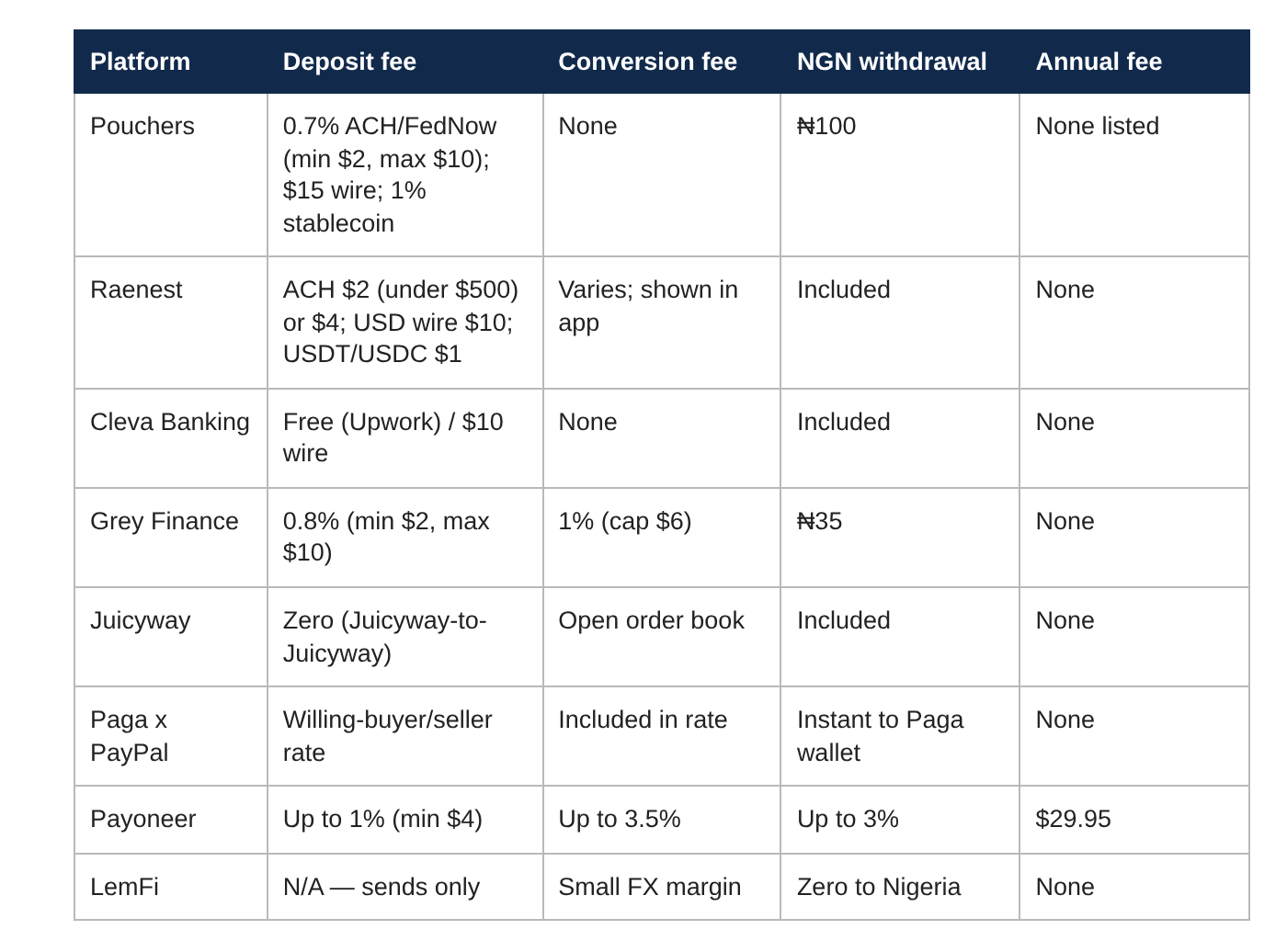
Most platforms hide their true cost across three separate charges: the deposit fee, the conversion fee, and the withdrawal fee. The table below shows the all-in picture. Read across the full row before deciding.
Fees verified at the time of publication (October 2026). Confirm directly with each platform before transacting, as rates change frequently.
The Full Rankings
1. Pouchers · Support for 8 stablecoin networks
Best Overall for All-in-One Global Payouts & Multi-Currency Accounts
If you are a Nigerian freelancer, creator, or remote professional receiving international funds, Pouchers stands out as the most comprehensive, low-friction payment app on the market today. While most platforms force users to choose between traditional fiat accounts or crypto rails, Pouchers combines USD, GBP, EUR, and multi-network stablecoin deposits into a single, unified wallet with zero tiered limits.
Why Pouchers Takes the #1 Spot
Zero Tiered Limits & Instant KYC: Complete identity verification within minutes and immediately unlock full account limits without jumping through artificial account tier restrictions.
Multi-Currency Virtual Accounts: Generate dedicated local bank account details for USD, GBP, and EUR to receive direct deposits via ACH, FedNow, Wire, and SEPA.
Widest Stablecoin Network Support: Receive crypto payments across 8 major networks: Ethereum, Tron, BNB Smart Chain, Polygon, Algorand, Arbitrum One, Base, and Solana, making it effortless for international web3 and tech clients to settle invoices.
Free Currency Conversion: Convert seamlessly between USD, GBP, EUR, Stablecoins, and NGN at zero markup fee.
Virtual Cards: Issue Visa and Mastercard virtual cards with no card funding fees for online subscriptions, software tools, and international purchases.
Pouchers Fee Structure
ACH / FedNow Deposit (USD): 0.7% (minimum $2, capped at $10 max)
US Wire Deposit: $15 flat rate
GBP & EUR Deposits: 0.7% (minimum $2, capped at $10 max equivalent)
Stablecoin Deposits: 1%
Currency Conversions:Free
Naira Withdrawals / Local Transfers:₦100 flat fee
Virtual Card Creation: $2 Standard / $5 Premium (Card funding is Free)
Limitations & Honest Drawbacks
To maintain transparency, keep these constraints in mind:
Nigeria-Only Settlements: Local currency bank withdrawals are currently restricted to Nigerian bank accounts.
Flat Naira Withdrawal Fee: Local bank transfers incur a flat ₦100 processing fee per transaction.
Who should use Pouchers? Anyone paid in more than one currency who converts often or who wants to receive in stablecoins and spend through a virtual card. For Nigerian freelancers, creators, and remote workers, Poucher offers the most versatile, low-friction settlement suite available. It combines USD, GBP, EUR virtual accounts and multi-network stablecoin payouts into a single wallet with zero tiered limits.
Best for Freelancers, Remote Workers, and the Global Nigerian Professional
Half the people who love Raenest still call it Geegpay (this author inclusive). That is not confusion, but rather loyalty so deep that a rebrand could not dislodge the name. When a platform earns that kind of grip, it usually means one thing: it solved a real problem at the exact moment people needed it solved.
Raenest launched in 2022 as a pivot from an Employer of Record startup, spotted the gap Nigerian freelancers had been complaining about for years, and built directly into it. The rebrand to Raenest in 2024 was accompanied by $11 million in Series A funding. Today, it serves over a million users, has processed more than $2 billion in payments, and has expanded into the US and India, positioning itself not as a Nigerian fintech but as the financial platform for Africans working globally.
What actually makes it the best
The headline feature is Raenest FastTrack: Upwork earnings credited to your account in under an hour, at any time, including weekends, at no extra cost. For anyone who has waited three business days to access money they already earned, this is not a nice-to-have. It changes how you plan your finances.
From December 2025, Raenest moved to zero deposit fees on USD, GBP, and EUR accounts: four free deposits per month, then $1 flat after that. It ended its four-free-deposits offer on 6 October 2026, so every deposit now carries a fee. ACH costs $2 under $500 and $4 from $500 up. A USD wire costs $10, USDT and USDC cost $1 ($2 on the TRON network), and EUR and GBP bank transfers cost 0.8% (minimum 1.50, maximum 10). Sending naira to a Nigerian bank account is free. The USD-to-naira conversion fee used to be 0.5% (minimum $0.25, maximum $2.70). Raenest now says it varies by transfer and shows it in the app before you confirm, so check it each time. There is no annual fee.
Beyond payments, Raenest has built a genuine financial platform. Physical and virtual USD cards. US stocks and ETFs are purchasable directly from the app. Stablecoin support across TRON, Ethereum, Solana, and Polygon. Invoicing tools. Transfers to 160+ countries. If you earn internationally and live in Nigeria, Raenest is built for the full shape of that life.
The honest limitations
Raenest's customer support is the most consistent complaint in independent reviews. The platform grows faster than its support infrastructure sometimes keeps up with. Card control features lag behind those of simpler apps. If you have a support issue on a Friday evening, you may have to wait.
Raenest's conversion fee is worth checking before every large conversion. It varies by transfer now, so the number the app shows you is the one that counts. Deposit fees are the other cost to plan for. Cleva charges nothing to convert and advertises free Upwork deposits, so for people paid through Upwork the gap with Raenest is real money.
"@raenestapp is the sweetheart." — CareerBuddy public survey
""@raenestapp outstanding" · "@raenestapp 👏👏👏" · "It's @raenestapp for me" — Multiple CareerBuddy public survey respondents, independently"
Who should use Raenest: Freelancers on Upwork and Fiverr who need the fastest possible payout settlement. Remote workers receiving USD, GBP, or EUR salaries. Anyone who wants a full financial platform — receive, invest, spend, and send — without managing five separate apps. The survey data from CareerBuddy's community is unambiguous: among Nigerian professionals who earn internationally, Raenest has the strongest organic following of any platform on this list.
3. Cleva Banking 700K+ users · Y Combinator W24
Best for Simplicity, Zero Conversion Fees, and Upwork Payouts
Cleva was built by people who had worked inside the payment infrastructure they were trying to replace. Co-founders Tolu Alabi and Philip Abel came from Stripe. They knew exactly where the friction was, and they designed around it. The result is a product that is narrower than Raenest in feature breadth but sharper in its core job: getting your dollars to your naira account as cleanly and cheaply as possible.
The number that matters most: Cleva’s strongest pricing claim is around Upwork: the platform advertises free Upwork deposits and no conversion fee. Other deposit methods are not universally free, however. Cleva’s pricing page shows that fees can vary by payment type, with wire deposits priced separately and ACH fees depending on amount.
The product in practice
Onboarding is fast; verified accounts ready in minutes. ACH transfers from US banks arrive in one to three business days. Wire transfers arrive within hours to one business day. Stablecoin deposits (USDT and USDC across TRON, Ethereum, and Solana) settle in minutes. The Cleva Points rewards programme credits earnings on every deposit and transaction, redeemable for USD. Over 700,000 users trust the platform, and App Store and Play Store reviews reflect a product that consistently delivers on its promises.
What Cleva does not do
Cleva is primarily built to receive money, not to fund it locally. You cannot top up your Cleva account from a Naira bank account and then spend in dollars. And if your clients are primarily in the UK and pay in GBP, Grey's multi-currency structure serves you better.
"@clevabanking has been the most reliable!" — CareerBuddy public survey
"@clevabanking always." — CareerBuddy public survey
Who should use Cleva: Freelancers whose primary income is USD from US clients. Anyone who receives regular Upwork or Fiverr payouts and wants the lowest all-in cost. If you convert to naira frequently, Cleva's zero conversion fee makes a measurable difference over time.
4. Grey Finance Strong public sentiment · 3,700+ Trustpilot reviews
Best for Multi-Currency Flexibility: USD, GBP, and EUR from One Platform
Grey did something specific and did it well: it gave Nigerian freelancers real foreign bank accounts at a time when that felt like it should require a UK address and six weeks of paperwork. Founded in 2020 as Aboki Africa and rebranded to Grey, it became the go-to for anyone who needed to receive from UK and European clients in their native currencies.
The multi-currency proposition is genuinely differentiated. Grey supports USD, GBP, EUR, and Naira accounts from one platform. For a freelancer whose client base spans the US, UK, and Europe, Grey is the only place where all three income streams land without a conversion step in between.
The fee reality
Grey charges 0.8% on deposits (minimum $2, maximum $10), 1% conversion fee when switching currencies (capped at $6), and ₦35 for naira withdrawals. On a £500 deposit, that is £4. On $1,000 converted to naira, that is $6. These are not outrageous numbers, but Cleva charges nothing to convert.
The friction points that appear consistently in reviews
Grey's KYC process is the most mentioned complaint in independent user reviews. The platform sometimes requests sender bank statements and identification, asking users to go back to clients for documentation that most professional clients find intrusive. Customer support response times also draw consistent criticism from users who need a resolution quickly.
"I have been using @greyfinance to receive international payments since last year, and it's stress-free, and the rate is reasonable." — CareerBuddy public survey
Who should use Grey: Freelancers and remote workers with significant UK and European client income who need GBP and EUR accounts alongside USD. Anyone who wants to hold multiple currencies without converting immediately. For USD-only income streams, Cleva or Raenest will be cheaper.
5. Juicyway $300M+ monthly volume · 12,000+ business clients
Best for Businesses, High-Volume FX, and Corporate Treasury
Juicyway spent three years not telling anyone it existed. It processed $1.3 billion in payments for 4,000 business clients, including Bolt, PiggyVest, Bamboo, and IHS, entirely through word of mouth, before publicly launching in December 2024. That backstory is not a quirky origin story. It is the most credible signal that a B2B financial platform can send: businesses that manage serious FX exposure trusted it without marketing.
The feature that no consumer platform offers: an open order book where you set your own exchange rate. Rather than accepting whatever rate the platform offers when you need to transact, Juicyway lets you specify a rate and wait for a match. For businesses converting significant naira/dollar volumes regularly, the ability to transact at your preferred rate is worth more than any percentage point in headline fees.
Juicyway also runs Naira Rates, Nigeria's largest price discovery engine for the naira, with nearly 500,000 Twitter followers tracking it for real-time FX data. The company is embedded in Nigeria's FX ecosystem at a level that retail platforms are not.
Who it is not for
Juicyway is not a freelancer app. The individual limit for Nigerian users is ₦100,000 per day / ₦500,000 per month**. It is a platform for businesses that need to manage FX as a treasury function: importers, exporters, funded startups, and logistics companies. If you are a company that previously banked with Mercury, which withdrew from Africa, Juicyway is the most credible replacement on this list.
*Who should use Juicyway: SMEs and businesses with regular international receivables or payables. Startups managing FX risk. Importers and exporters who need competitive rates on large volumes. Any company that has outgrown retail fintech platforms but is not yet large enough for full banking treasury relationships.
*Juicyway is available to both individuals and businesses, but the user experience depends heavily on the account tier. For Nigerian individual users, Juicyway says tier 1 and tier 2 accounts are limited to ₦100,000 daily or ₦500,000 monthly, while tier 3 accounts can access much higher limits, including ₦5,000,000 daily and ₦20,000,000 monthly.
6. Payoneer High fees · 190+ countries
Best Backup for Platform Compatibility — Not Your Primary Account
Here is the honest Payoneer verdict for Nigerian professionals in 2026: keep the account, do not make it your primary receiving platform.
Payoneer has been the default for Nigerian freelancers for over a decade because it was often the only option platforms supported. That infrastructure advantage still exists; Payoneer supports 190+ countries and integrates with more freelance and e-commerce platforms than any other option on this list.
But using Payoneer as your primary home for earnings in 2026 means accepting fees that should make any professional uncomfortable. Total costs for low-volume users can reach 8.5%: up to 1% for receiving, up to 3.5% for currency conversion, up to 3% for withdrawals to Nigerian banks, plus a $29.95 annual card fee. On $12,000 in annual earnings, that is over $1,000 in fees. Raenest, Cleva, and Grey together cost a fraction of that for the same transaction volume.
There is also the account blocking problem. Accounts suspended without warning, without clear explanation, with no recourse beyond email chains that go nowhere. The risk of platform dependency on a single account that can be terminated unilaterally is not hypothetical for Nigerian users.
The right Payoneer strategy in 2026: Keep a verified Payoneer account for platforms that require it. Route those payments to a Nigerian fintech (Raenest or Cleva) via ACH or wire as quickly as possible. Do not hold significant balances in Payoneer. Do not convert to naira through Payoneer. Use it as a corridor, not a home.
7. Paga x PayPal 21M Paga users · 400M+ PayPal payers · Launched January 2026
Best for PayPal Clients and Global Marketplace Access — Twenty Years in the Making
PayPal excluded Nigerian accounts from receiving inbound payments in 2004, citing fraud concerns. That decision locked Nigerian freelancers, creators, and online sellers out of the world's most widely accepted payment network for the next twenty years. Every Nigerian who built a client relationship with someone who paid by PayPal either had to explain a workaround, lose the client, or route funds through a Grey virtual account connected to a PayPal account opened in another country. None of it was clean.
In January 2026, that exclusion ended. PayPal partnered with Paga — one of Nigeria's largest fintech platforms, with 21 million users and ₦17 trillion processed in 2025 alone — to enable inbound PayPal payments into Nigeria for the first time. Nigerian users can now link their PayPal accounts to their Paga wallets, receive payments from clients in 200+ countries, and withdraw instantly in naira. They can also hold dollar balances and spend globally at merchants that accept PayPal. Venmo interoperability means US-based clients can pay directly from Venmo without any friction on their end.
What it means in practice
For freelancers and remote workers with US or European clients who pay by PayPal, designers, writers, developers, and consultants, this removes the conversation entirely. Your client pays the way they always pay. The money arrives in your Paga wallet, is converted to naira at willing-buyer/willing-seller rates, and then transferred to your bank account.
For Nigerian merchants selling on global platforms that process payments through PayPal, the integration provides access to 400 million PayPal users without requiring any new setup on the buyer side. Paga's existing merchant ecosystem (bill payments, bank transfers, Visa card spending) means funds received from PayPal can be deployed immediately within Nigeria's financial infrastructure.
The honest reality
The Paga x PayPal integration launched in January 2026. The promise is real, and the infrastructure behind it is credible; Paga is a serious, regulated platform, and PayPal's $100 million commitment to the Middle East and Africa markets signals genuine long-term intent. But conversion rates, onboarding speed, and edge-case reliability are still being proven in production. Nigerian users have been disappointed by PayPal partnership announcements before; for instance, the 2014 First Bank arrangement enabled outbound payments only, and the 2021 Flutterwave integration focused on businesses rather than individuals. This one is different in scope, but the fair expectation is to verify the experience before routing primary income through it.
Monitor the Paga x PayPal integration actively during its first year. If your clients pay primarily via PayPal, it's worth setting up the integration now and testing it with real transactions. Do not migrate your entire payment workflow away from an established platform until you have confirmed that the new one reliably handles your specific payment type.
Who should use Paga x PayPal: Freelancers and remote workers whose clients pay by PayPal and have historically struggled with inbound payment workarounds. Nigerian merchants selling on global platforms that disburse through PayPal.
8. LemFi 2M+ users · Diaspora-first
Best for Diaspora Sending Money to Nigeria
LemFi is on this list because it is genuinely excellent at what it does. It is not on this list for the reason most Nigerian professionals might assume.
LemFi is strongest as a remittance product for Nigerians and other Africans abroad sending money home. It is not primarily positioned as a platform for Nigeria-based freelancers receiving direct client payments into local professional workflows. For that reason, it fits better as a diaspora-to-Nigeria transfer option than as a primary receivables account for users based in Nigeria. A product built with a deep understanding of what diaspora financial life actually looks like: supporting family, paying school fees, managing emergencies across time zones.
What LemFi is not: a platform for Nigerians in Nigeria to receive international client payments. If you are based in Lagos and your US client wants to pay you, you cannot sign up for LemFi to receive that money. LemFi’s service flows from outside Nigeria into Nigeria, not the other way around.
"My lemonade experience has been one of bliss after my brother recommended it to me. I am able to send money to my family in Nigeria quickly, especially in emergency situations." — LemFi user review
Who should use LemFi: Nigerians in the UK, the US, Canada, and Europe who are sending money home. Families managing regular remittances. Not suitable for freelancers or remote workers in Nigeria trying to receive international client payments.
Has processed transfers to Nigeria for over a decade and supports multiple payout methods, including bank deposits, mobile money, and cash pickup, which is useful for recipients without smartphone access. Fees and rates trail those of Nigerian-native platforms in the USD-to-NGN corridor, but the cash pickup option makes it uniquely useful in specific circumstances.
Is an emerging platform gaining traction among Nigerian freelancers for multi-currency accounts and virtual USD card functionality. Independent user reviews are positive but limited. Verify regulatory status and confirm features directly before use as a primary account.
Targets the Nigerian gig economy specifically. Early feedback is encouraging. Insufficient independent data at time of publication for a full assessment; all worth monitoring.
What Most Nigerian Professionals Get Wrong About International Payments
The most expensive mistake is using Payoneer as a primary receiving and conversion platform when Nigerian-native alternatives have been available for years. The second most expensive mistake is focusing exclusively on the headline deposit fee while ignoring the conversion fee; a platform that charges nothing to receive but 1% to convert will cost more than one that charges $1 to receive and nothing to convert, for any user who converts regularly.
The third mistake is building a single-platform dependency. Payoneer accounts get blocked. Grey accounts face KYC holds. Raenest’s customer support can be slow during high-volume periods. The professionals who manage international income most effectively maintain two accounts: typically, a primary platform for regular work income and Payoneer as a fallback for platforms that require it specifically.
Settlement speed is a hidden cost that most fee comparisons ignore. A platform that delivers your money in two hours costs less than one that delivers it in three days, even if the listed fees are identical. For freelancers managing cash flow across multiple projects and clients, this matters more than the fraction-of-a-percent difference in conversion rates.
Frequently Asked Questions
What is the best app to receive international payments in Nigeria in 2026?
For freelancers and remote workers, Raenest, Pouchers, and Cleva Banking lead in 2026. Raenest has the strongest full-platform offering: FastTrack payouts, US stock investment, multi-currency support, and flat ACH deposit fees of $2 to $4. Pouchers is our top-ranked pick for people who hold several currencies or stablecoins in one wallet. Cleva leads on fee simplicity, with free Upwork deposits and zero conversion fees. For multi-currency needs across USD, GBP, and EUR, Grey Finance is the strongest option. For businesses managing significant FX volume, Juicyway is in a category of its own.
What happened to Geegpay? Is it the same as Raenest?
Yes. Geegpay rebranded to Raenest in 2024 following $11 million in Series A funding. The product has expanded significantly, but existing users kept their accounts. If you know it as Geegpay, you are using Raenest.
Can I receive dollars in Nigeria without a domiciliary account?
Yes. Several fintech platforms, such as Raenest, Cleva, Grey Finance, and Juicyway, now provide USD account details or virtual foreign account functionality to eligible users, though the exact product, account type, and verification requirements differ by provider. Users should still confirm the latest onboarding, compliance, and payout rules directly with the platform before relying on it for client payments.
Is Payoneer still worth using in Nigeria in 2026?
Keep Payoneer as a secondary account for platforms that require it. Do not use it as your primary conversion or holding platform, as total fees can reach 8.5% plus a $29.95 annual fee. Route Payoneer receipts to Raenest or Cleva as quickly as possible.
What is the cheapest way to receive international payments in Nigeria?
For many Nigeria-based freelancers receiving USD income, Cleva and Raenest currently present some of the strongest pricing propositions, but the cheapest option depends on how you get paid. Cleva Banking currently offers the lowest all-in cost for most users: free Upwork deposits with no monthly limit, no conversion fee, and no annual fee. Raenest charges flat deposit fees ($2 on ACH under $500, $4 from $500 up) and shows its conversion fee in the app before you confirm, which makes it competitive on larger ACH deposits. Grey charges 0.8% on deposits and 1% on conversion. Upwork users may benefit from Cleva’s free Upwork deposits, while Raenest may be competitive for users who stay within its eligible free monthly deposit allowance and value its capped conversion fee. Grey remains useful for users who need GBP and EUR support in addition to USD.
Pouchers charges nothing to convert but 0.7% to deposit by ACH (capped at $10), so it suits people who convert often more than people who only receive and withdraw.
Can I use LemFi in Nigeria to receive international payments?
LemFi is designed for Nigerians abroad sending money home, not for Nigerians in Nigeria receiving international client payments. If you are based in Nigeria, use Raenest, Cleva, or Grey for receiving. Recommend LemFi to family abroad who sends money regularly.
Final Verdict
The story of international payments for Nigerian professionals in 2026 is one of genuine progress, earned by founders who were tired of losing their own money to broken infrastructure. Pouchers, Raenest, Cleva, Grey, and Juicyway exist because Nigerian professionals needed them, and they were built by people who understood exactly why.
The right platform depends on the direction your money moves, the currencies your clients pay in, and how often you convert. No single platform wins everything. Raenest suits Upwork freelancers who want fast payouts and a full financial app. Cleva suits USD earners who convert often and want the lowest conversion cost. Grey suits people paid in GBP and EUR as well as dollars. Pouchers suits people who hold several currencies or stablecoins and convert often. Whichever you pick, keeping Payoneer as a backup costs far less than a Payoneer-only workflow, and a second Nigerian account covers you when one is delayed or under review.
The international payments market for Nigerian professionals is meaningfully better than it was a few years ago. Platforms like Pouchers, Raenest, Cleva, Grey, and Juicyway have created more options for users who previously had to rely on a smaller set of global providers, often with less flexibility and less local relevance.
Before you switch platforms: Verify current fees directly with each provider before transacting. Maintain at least two accounts during any transition period. Do not close your existing account until you have confirmed the new one is fully functional for your specific payment sources.