Best Business Payment Gateways in Nigeria (2026): Ranked for SMEs & Founders
QUICK ANSWER
Best for startups and e-commerce: Paystack — simplest integration, best developer docs, trusted by 60,000+ businesses. Start here.
Best for cross-border and multi-currency: Flutterwave — 150+ currencies, pan-African reach, $31B processed in 2024. Know the history.
Best for bank transfer-heavy B2B businesses: Monnify — virtual accounts, automated reconciliation, Moniepoint reliability.
Best for fintech builders needing API-first plus stablecoin: Fincra — $10B+ processed, fiat and crypto rails from one integration.
Best for enterprise and government: Remita — the backbone of Nigerian federal salary and institutional payments.
Best for businesses already with GTBank: Squad — deep banking integration, competitive fees, reliable settlement.
Introduction: The Payment Gateway Decision Nobody Takes Seriously Enough
Every Nigerian business that decides to accept online payments makes the same mistake at least once: it picks a gateway based on what other founders are using and discovers six months later that it was built for a different type of business. The startup that picked Paystack for its clean checkout later realized that 70% of its customers prefer bank transfer, and Monnify's virtual account reconciliation would have saved ten hours of monthly admin. The B2B company that chose Flutterwave for its brand cachet discovers it is paying 2% per transaction on invoices where Monnify would have charged 1.4%.
Nigeria's payment gateway market has matured to the point where the right answer genuinely depends on your business model. Paystack and Flutterwave are the names every founder knows. But the conversation in 2026 includes some newer players than you'd usually think! This ranking maps each gateway to the business it is actually designed for.
All fees verified at time of publication — June 2026. Payment gateway fees change frequently and vary by payment method, transaction volume, and negotiated agreements. Confirm current pricing with each provider before integrating.
Fee Comparison: The All-In View
The table below captures headline transaction fees. The real cost is always higher once you account for the specific payment method, currency, and settlement timing you actually use. Read it as a starting point, not a final answer.
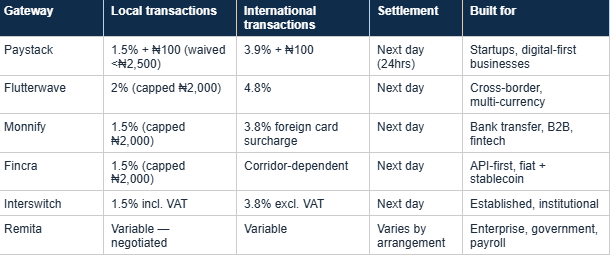
Fees confirmed at time of publication. Always verify current rates directly with providers as they shift with CBN directives and business volume negotiations.
The Full Rankings
1 Paystack
60,000+ businesses · Stripe-backed · Best developer docs in Nigeria
Best for Startups, Digital Commerce, and Any Business Going Live Fast

Paystack was founded in Lagos in 2015 and acquired by Stripe for over $200 million in 2020. That acquisition matters in a way that is still playing out: Stripe invested not just money but engineering standards, documentation culture, and global compliance infrastructure into a Nigerian payment company. The result is visible in the product. Paystack's developer documentation is the best-maintained in the Nigerian market. A competent developer can go from zero to live checkout in a day. The webhook and API reliability is consistent. The dashboard is clean enough that non-technical founders can manage their payments without needing a developer for every adjustment.
For a startup or SME that wants to start collecting payments online without a procurement process, Paystack is the fastest, lowest-friction path. No setup fees. A 1.5% + ₦100 per transaction structure that is affordable for early-stage businesses. Support for debit cards, bank transfers, USSD, and Apple Pay; which covers effectively every Nigerian customer's preferred payment method. Payment links that work even without a website.
The payment link feature deserves specific mention: businesses with no website, no app, and no developer can generate a payment link from the Paystack dashboard in seconds and share it via WhatsApp, Instagram, or email. For the wave of Nigerian SMEs that sell primarily through social media, this single feature has been more valuable than the entire Stripe-grade checkout infrastructure.
The honest limitations
At higher transaction values, Paystack's structure can cost more than alternatives. A ₦500,000 invoice processed through Paystack costs ₦7,600 (1.5% + ₦100). The same invoice through Monnify costs ₦7,100 (1.4%, capped at ₦2,000) — a small difference per transaction that compounds meaningfully for businesses doing serious B2B volume. Paystack is also fundamentally card-and-checkout-first in its product DNA. For businesses where the majority of customers pay by bank transfer — which in Nigeria, particularly for high-value B2B transactions, is most businesses; Monnify's infrastructure is more purpose-built.
Who should use Paystack: Startups, e-commerce stores, digital product sellers, subscription businesses, service providers, and any company that wants to be live accepting payments within 24 hours. If you are not sure which gateway to start with, start with Paystack and migrate when your transaction pattern tells you something more specific is needed.
2 Flutterwave
$31B processed 2024 · 150+ currencies · 34 African markets
Best for Cross-Border Commerce and Pan-African Businesses — Know the History

Flutterwave processed $31 billion in transaction value in 2024. That number settles one question permanently: at scale, across Africa and internationally, Flutterwave works. Over a million businesses use it. Uber, Netflix, and Flutterwave's African merchant base process payments through its infrastructure daily. For a Nigerian business with genuine pan-African or international ambitions — accepting payments from Ghana, Kenya, Côte d'Ivoire, South Africa, and the UK simultaneously — Flutterwave is the only local-origin gateway that handles all of those corridors from a single integration.
The multi-currency capability is the product's clearest differentiator. 150+ currencies. PayPal integration. Mobile money across Africa. USSD. Cards. POS. The Flutterwave Store allows businesses with no website to sell globally. The Rave checkout is configurable for complex payment flows. The acquired Mono open-banking infrastructure (January 2026) adds account verification and bank data capabilities that no other gateway in this list currently offers.
The history you need to know before deciding
Flutterwave has accumulated a significant regulatory and governance record since 2022 that any business integrating it should understand before making the decision. The Kenyan Asset Recovery Agency froze $52 million in Flutterwave-linked accounts in 2022 on money laundering suspicions; charges later dropped by the ARA for lack of evidence. In early 2023, a court-documented security breach resulted in approximately $24 million in unauthorised POS transactions. In April 2024, a further breach led to reportedly $7.2 million in illicit transfers. In July 2025, Flutterwave cut roughly 50% of staff in Kenya and South Africa as part of a restructuring. Multiple allegations of workplace harassment and governance failures have accompanied these operational issues.
The full picture: Flutterwave's scale and market position make it, in the words of multiple fintech analysts, 'almost too big to fail.' Its client base and infrastructure are too embedded in African commerce for the platform to simply disappear. But the governance and security record means that any business integrating Flutterwave should do so with eyes open, monitoring for service disruptions, maintaining a fallback gateway, and not treating Flutterwave's continued operation as guaranteed.
The verdict on whether to use Flutterwave is a business decision, not a moral one. If you need pan-African multi-currency payment acceptance, Flutterwave's infrastructure capabilities are genuinely unmatched in the local-origin market. If you operate primarily within Nigeria with Nigerian customers paying in naira, Paystack's cleaner governance record and more focused product may suit you better.
Who should use Flutterwave: Businesses with cross-border or pan-African payment needs. E-commerce platforms accepting multiple African currencies. Companies needing PayPal integration or multi-currency checkout. Integrate with a fallback gateway and maintain awareness of its operational track record.
3 Monnify
Moniepoint subsidiary · Owns CBN switching licence · Lowest effective B2B fees
Best for Bank Transfer-Heavy Businesses — Virtual Accounts and Automated Reconciliation

Most Nigerian customers, particularly for high-value transactions, prefer bank transfer over card. This is not a demographic quirk; it is a rational response to years of card failure rates, fraud exposure, and the simple reliability of bank-to-bank transfer in a market where NIBSS bank transfers rarely fail. Monnify is the gateway that was built around this reality rather than imported from a card-first global template.
Monnify is Moniepoint's payment gateway product, and it inherits Moniepoint's core competency: making bank transfer flows work reliably at scale. The product that makes it genuinely different from Paystack and Flutterwave is the virtual account infrastructure. Monnify assigns dedicated virtual bank account numbers to individual customers or transactions, allowing incoming bank transfers to be automatically matched and reconciled without a human touching a spreadsheet. For businesses processing dozens or hundreds of bank transfers dail: schools collecting fees, B2B platforms receiving invoices, lending companies receiving loan repayments, this automation is worth more than any headline fee comparison.
Pricing: 1.5% per local transaction, capped at ₦2,000. Foreign card transactions attract an extra 3.8% charge. Settlement next-day. Monnify owns a CBN switching licence (one of only two Nigerian payment companies to hold one alongside Interswitch) which reduces its own processing costs and translates into pricing that is competitive without sacrificing margin sustainability.
Monnify's parent Moniepoint processes over 800 million monthly transactions and has achieved unicorn status. The infrastructure reliability that made Moniepoint Nigeria's most trusted POS provider is the same infrastructure Monnify runs on. For businesses where payment failure during a peak period is genuinely costly, that backstop matters.
The honest limitations
Monnify's developer documentation, while functional, does not match Paystack's polish. Non-technical business owners will find the integration less intuitive. The brand is less recognisable to end customers, which occasionally creates checkout trust friction. And for businesses that primarily process card payments from consumers: e-commerce, digital subscriptions, Paystack's consumer-facing checkout experience is more developed.
Who should use Monnify: Fintechs, lending platforms, schools, B2B service businesses, marketplaces, and any company where bank transfers are the primary inbound payment method. If you find yourself manually reconciling bank transfers every month, Monnify's virtual account infrastructure is the solution that should have been in place from day one.
4 Fincra
$10B+ processed · IMTO-licensed · Fiat and crypto rails
Best for API-First Products and Fintech Builders Needing Fiat Plus Stablecoin

Fincra launched in 2021 with an explicit mandate that most Nigerian payment companies have not attempted: build a payment infrastructure that works across African borders at the API level, simultaneously on fiat and stablecoin rails. Between 2023 and 2024, it processed over $10 billion in transaction value, less than Flutterwave by an order of magnitude, but enough to establish production-grade reliability across its corridors.
The distinguishing feature for developers building payment-intensive products is Fincra's dual-rail architecture. The same API handles fiat pay-ins and pay-outs (payment gateway, payment links, permanent virtual accounts, bulk disbursements) as well as stablecoin-settled transactions. For a Nigerian fintech building a product that involves cross-border settlements, a payroll platform, an e-commerce marketplace, and a business banking product, the ability to settle via USDT or USDC alongside naira bank transfers from a single integration eliminates the need for a separate crypto payment infrastructure.
Fincra holds an IMTO license from the CBN, enabling it to process international money transfers, not just domestic payments. That license distinguishes it from gateways that handle naira-to-naira flows only and positions it as a complete cross-border payment infrastructure rather than a local checkout product.
The honest limitations
Fincra is a developer-first product. Non-technical businesses will struggle to integrate it without engineering support. The brand is less well known to end customers than Paystack or Flutterwave, which occasionally creates checkout trust friction. For businesses that do not need stablecoin rails or IMTO-level cross-border capability, Paystack or Monnify offer more purpose-fit solutions.
Who should use Fincra: Fintech startups building payment products that span multiple African countries. Companies that need both fiat bank transfers and stablecoin settlements from a single API. Developer teams building anything that requires IMTO-licensed cross-border transfers alongside domestic naira flows.
5 Interswitch / Quickteller Business
Nigeria's foundational payment infrastructure · 25+ years · 1.2B transactions
Best for Established Businesses with Traditional Banking Depth