
    Degree or Skills? HRs Reveal the Truth About Hiring in 2025

    Is skill-based hiring the future? Discover why industries are shifting from degree-based hiring, which skills are in demand, and how job seekers can land top roles without a degree. Expert insights, real-world data, and career tips inside!

    Jump to
    Degree or Skills? HRs Reveal the Truth About Hiring in 2025
    Illustration · CareerBuddy

    There’s no need even to have a college degree…at all. Or even high school. If somebody graduated from a great university, that may be an indication that they will be capable of great things, but it’s not necessarily the case. If you look at people like Bill Gates, Larry Ellison, and Steve Jobs, these guys didn’t graduate from college. But if you had a chance to hire them, of course, that would be…a good idea.

    Are you surprised these words came straight from the mouth of the wealthiest man in the world, Elon Musk?

    Many of the most successful individuals (in this context, success refers to attaining wealth, doing what you enjoy, having freedom, and leveraging people to buy back time) share Elon’s view.

    So, if the ultimate goal for almost every individual is to achieve success, does this mean abandoning the traditional pathway of going to school, getting a job, saving or investing and retiring?

    Who better to answer this than the HR leaders, talent acquisition experts and recruiters right at the heart of hiring decisions? That’s why I reached out to top industry professionals; People who have years of experience in screening, assessing and hiring talent across various industries.

    This article will answer some of the most frequently asked questions surrounding skill-based hiring vs. degree-based hiring, including:

    • Which hiring model is more effective?

    • Why are companies shifting towards skill-based hiring?

    • How do recruiters assess skills without degrees?

    • What’s the future of hiring?

    • As a job seeker, how can you position yourself for success? Degree or not

    First…

    What Does Degree-Based Hiring Mean?

    Hiring based on a degree simply means solely hiring individuals who have gone through the traditional route of education and attained certifications in their relevant fields of study.

    For decades, companies have used degrees as a hiring filter because they:

    • Serve as a benchmark for knowledge and discipline.

    • Indicate that candidates have undergone a structured learning process.

    • Make resume screening easier for recruiters by narrowing down applicants.

    Industries like medicine, law, and engineering still heavily rely on degree-based hiring due to regulatory, safety, and ethical concerns.

    What Does Skill-Based Hiring Mean?

    Skill-based hiring is the complete opposite of degree-based hiring. In this case, the major requirement isn’t the individuals' educational certification, but rather, their relevant skills needed for the job role. In practical terms, a person doesn’t have to graduate from an institution with certifications to be hired. 

    In skill-based hiring, the focus is on:

    • Portfolios showcasing work done

    • Technical assessments and real-world problem-solving

    • Hands-on experience, apprenticeships, and certifications

    • Ability to learn and adapt quickly

    Next, let’s look at the data on these different types of hiring.

    Skill vs Degree-Based Hiring Data
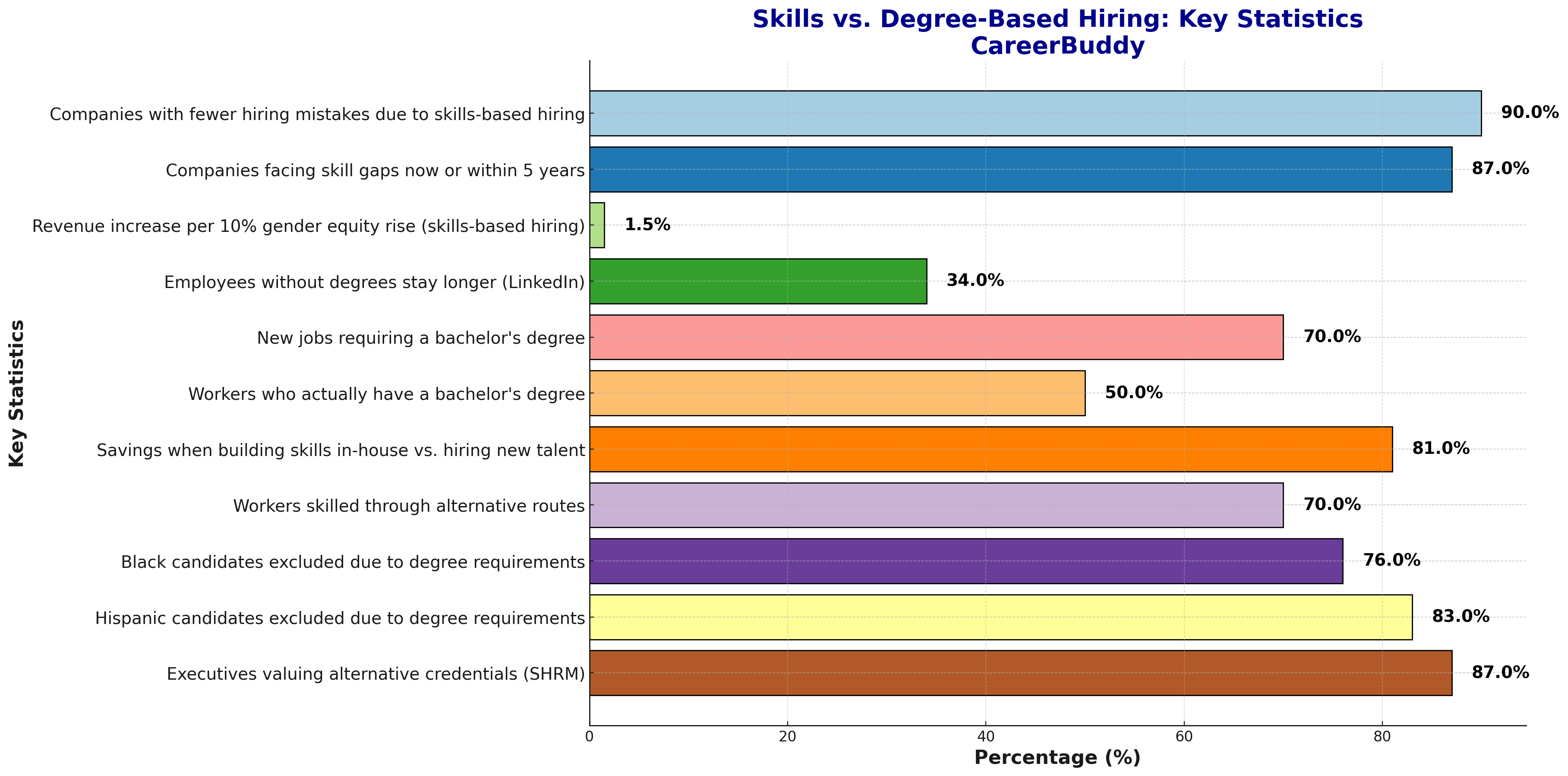
    These stats are intriguing. Clearly, there’s a massive incline towards skill-based hiring and it has undeniably shown advantages compared to the latter. Before we go on to hear from our HRs, is it safe to assume skill-based hiring is a necessity for most companies? 

    (Original data gotten from Forbes, The Times Reports, Harvard Business School, HackerRank, LinkedIn Data, Opportunity@Work, Jobs for the Future and SHRM respectively).

    If there’s anyone who saw this unfolding gradually over the years, it’s Eniola Bello. Eniola has over 15 years of transformative experience in HR management and business excellence. She also has an impressive combined transition into tech.

    We did not get here in a matter of a day; it had been a gradual and profound process. There does exist a disparity between academic qualifications and the practical requirements of the current work environment. For a very long time, I have witnessed a good number of those who do not possess formal degrees outperforming those who have degrees. Although I encouraged such persons to receive their degrees for advancement and promotions purposes.

    Why is This Incline Toward Skill-Based Hiring Happening?

    1. Application and Proof of Skills: 

    Studying is one thing, but applying those skills in real life is another. 

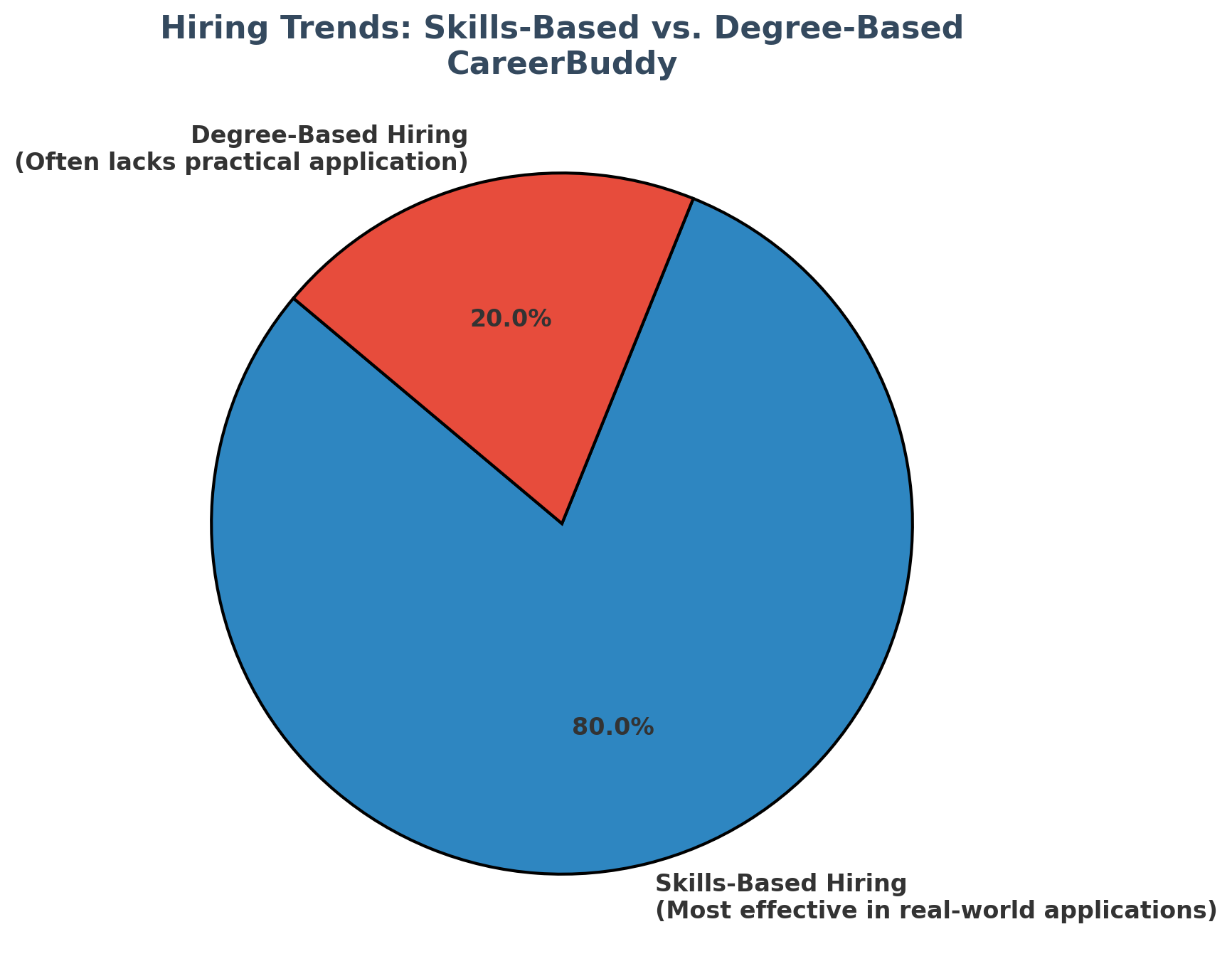
    After speaking with our HR and Talent Acquisition experts, 60% stated that the inability to apply learned skills in work environments is a key reason they prefer skill-based hiring over degree-based hiring.
    Esther Abayomi, a Global Talent Sourcer and Technical Talent Acquisition Researcher at AltexSoft, is known for her ability to match top talent with the right companies. Passionate about helping people find the right opportunities, she shared her experience with me:

    I still remember early in my career when I recruited a candidate who looked perfect on paper:  Great education coupled with an impressive experience. But they struggled to perform in the role. Around the same time, another candidate, with no fancy degree but years of hands-on experience, absolutely thrived. It was a wake-up call for me. This made me realize that sometimes, the best hires aren’t the ones who look perfect on paper but the ones who bring grit, adaptability, and the kind of experience you can’t teach in a classroom.

    Similarly, Esther Ajao, a Talent Acquisition Professional and Recruiter, has experience hiring for both technical and non-technical roles. She’s dedicated to building strong relationships, making the hiring process more efficient, and helping companies find exceptional talent.

    One of the main reasons companies are shifting to skill-based hiring is that it focuses on what a candidate can actually do rather than just their degree. The job market is evolving quickly, and many roles require up-to-date skills that a degree alone doesn’t always provide. With more people gaining these skills through online courses and hands-on experience, employers are prioritizing practical abilities. This shift not only helps companies build more diverse teams but also speeds up hiring by evaluating potential and performance rather than just traditional qualifications. Esther Ajao

    Another interesting personal perspective was shared by Ademola Somorin, an HR professional with over a decade of experience in human resource management:

    Let me give a personal example. I know of a 3rd year engineer whom if he resigns will impact the products of his company. In fact, I’d argue that he performs even better than some degree holders. Many of the talents we HR's come across, despite having degrees, struggle to meet job expectations, leaving managers with the burden of training them. On the flip side, there are individuals who have put in the hard work, upskilled themselves, and are more than capable of excelling in their roles. - Ademola Somorin

    2. Technology’s Fast Growth:

    There’s no denying how technology has played a huge role in skill-based hiring, especially with the advent of AI and, more recently, Agentics. 

    Access to information has never been easier. This accessibility has challenged the traditional view that a degree is the only path to career success.

    First, technology is evolving so fast that traditional degrees can’t always keep up. Companies need people who can do the work, not just talk about it. Second, businesses are finally realizing that great talent comes from all backgrounds not just the usual "top schools" or conventional career paths. - Esther Abayomi

    The pace at which technology is progressing is creating an appetite for specialized and current skills that academic institutions are not able to provide. At the same time, the increasing prices of higher education have made a large number of potential scholars search for other alternatives to acquire necessary skills, such as online courses, apprenticeship training, and boot camps. - Eniola Bello

    3. Talent Gap:

    The talent gap is one of the most pressing workforce issues today, and it is affecting almost every industry across the globe. You’d expect that with the advancements in every field, this gap should shrink. However, millions of jobs remain unfilled due to a lack of qualified candidates with the right skills. A (WEF) report states that by 2025, nearly 50% of all employees will need reskilling.

    "I would say the noticeable shift from degree-based hiring to skill-based hiring is because there's a gap in the supply of qualified candidates today. Also, attracting qualified talent has become challenging as more companies focus on employer branding and creating a better work environment, leading to candidates having multiple offers to choose from.

    Using the tech industry as an example, we have a lot of people trying to break into tech, learning from YouTube, online courses, and internships, basically compressing a four-year degree into six months or a year. In my opinion, skill-based hiring is a new way recruiters can improve their talent supply." - Ademola Somorin

    Esther Ajao also weighed in on this issue:

    “Qualifications provide the necessary theoretical foundation, while skills demonstrate the ability to apply that knowledge. During my interview sessions, I also focus on skills. This balance leads to stronger teams that are not only knowledgeable but also adaptable, results-driven and capable of innovative problem-solving.” - Esther Ajao

    This begs the next question…

    How Can Recruiters Assess Candidates in Skill-Based Hiring?

    Here’s what HR experts recommend:

    1. Don’t Skip Proper Assessments:

    Despite the advantages of skill-based hiring over degree-based hiring, we will not throw caution to the wind and hire arbitrarily. We need to assess exactly what these candidates have learned, how relevant their skills are to the workplace, and whether they are a cultural fit. Competency-based assessments and culture-fit interviews help evaluate their abilities, and if successful, they are placed on probation to further validate that they are the right fit. - Ademola Somorin

    2. Real-World Application:

    “But how do we, as recruiters, actually assess skills beyond a resume? That’s where things get interesting. I’ve found that structured interviews, real-world case studies, and skills-based assessments are far better predictors of success. Tools like LinkedIn, ATS platforms, and even tech community collaborations give us deeper insights into a candidate’s actual expertise.” - Esther Abayomi.

    3. Recommendations and Work Samples:

    “We can use practical assessments and skill-specific tests, along with work samples or portfolios that highlight a candidate’s past projects. Certifications and recommendations from previous employers can also give us extra insight into a candidate's abilities. This way, we get a much clearer picture of how well a candidate can perform in the role.” - Esther Ajao

    4. Employer Branding: 

    Recruitment marketing and employer branding are areas HR teams should pay more attention to for them to attract and retain quality talents.” - Ademola Somorin

    Skill-Based vs. Degree-Based Hiring: Which Works Best by Industry?

    When it comes to hiring, there’s no universal approach that works for every industry. Let’s take a closer look at which industries rely more on degrees, which prioritize skills, and where a hybrid approach makes the most sense.

    1. Tech & software development → Skill-based hiring

    2. Marketing, design & creative fields → Hybrid (skills + degree optional)

    3. Healthcare & medical professions → Degree-based hiring (with skill validation)

    4. Finance, business & consulting → Hybrid (degrees preferred, certifications & experience valued)

    5. Skilled trades (plumbing, electricians, mechanics) → Skill-based hiring

    6. Law & legal professions → Degree-based hiring (with experience considered)

    How to Get Hired Without a Degree (For Job Seekers)

    1. Identify high-demand skills & specialize

    2. Learn through online courses & certifications

    3. Build a strong portfolio

    4. Gain real-world experience (freelance, internships, or side projects)

    5. Network like your career depends on it (because it does)

    6. Optimize your resume & LinkedIn profile for skill-based hiring

    7. Apply to companies that hire without degrees

    Overall, your career success isn’t defined by a degree, it’s defined by the skills you build and the opportunities you create.

    Does This Make a Degree Less Important?

    Not necessarily. A degree can still open doors, especially in certain fields that require formal education (medicine, law, engineering). But in many industries, especially tech, marketing, design and entrepreneurship, skills, experience and networking matter more than a diploma.

    So, while a degree can help, it’s no longer the only (or even the best) path to success. A great example of this is Eniola’s story:

    My personal narrative starts from the United Kingdom, where I was welcomed to the world of work at the age of seventeen. Right from the get-go, I adopted the principle of valuing real-life experience and applicability while trying to obtain formal qualifications. While I agree with the essence of education, I do believe that there are important factors to consider regarding a person not having a specific degree. Most of the time, the absence of a degree may in fact be tantamount to having real-life experience in a profession with shifting dimensions - Eniola Bello

    Final Words

    Degrees still hold value in regulated fields like medicine and law, but in many industries like tech, marketing, and business, employers are prioritizing skills over formal education.

    For employers, this means looking beyond degrees and focusing on practical ability, problem-solving skills, and adaptability. Instead of relying on traditional hiring filters, companies are now seeking candidates who can demonstrate real expertise and impact in their roles.

    For job seekers: skills matter more than credentials. Especially if you want to stand out and land great opportunities in the job market.

    At the end of the day, AI might change the way we recruit, but human potential is still what drives business success. By focusing on skills over pedigree, we open doors for talented individuals who might have otherwise been overlooked. - Esther Abayomi

    FAQs

    1. Which degrees have more demand?

    Based on job market trends, these degrees have the strongest demand: Healthcare & Medical degrees, Technology & Computer Science, Engineering degrees, Finance & Business degrees, Environmental & Renewable Energy fields 

    If you're researching career paths, check industry reports from LinkedIn, Glassdoor, or the U.S. Bureau of Labor Statistics to see projected job growth.

    2. Which skill has more demand?

    The most in-demand skills in 2024 include: AI & Machine Learning, Cybersecurity, Software Development, Digital Marketing & SEO, Project Management, Sales & Business Development, UX/UI Design & Product Management. 

    3. Why is talent better than education?

    Talent is the ability to apply knowledge, solve problems, and create value, whereas education is the process of acquiring knowledge. While education provides a foundation, talent determines how well a person can execute tasks, innovate, and adapt.

    4. What are the 7 soft skills?

    Soft skills are non-technical abilities that influence how well you work with others and handle tasks. The seven most important soft skills for career success are: Communication, Problem-Solving, Adaptability, Time Management, Emotional Intelligence (EQ), Teamwork & Collaboration, Leadership & Decision-Making.

    Recruiters often search for these soft skills in resumes and job applications. If you’re job-seeking, include specific examples of how you’ve demonstrated these skills in your past roles.

    Advertisement

    Advertisement

    In-Article Ad

    Native ad placement

    Ultimate CV Template for African Tech Roles
    Free Download

    Ultimate CV Template for African Tech Roles

    ATS-friendly CV template designed for tech jobs in Lagos, Nairobi, Cape Town, and remote positions.

    Get this on WhatsApp

    Join the CareerBuddy WhatsApp Group for daily career, salary, and AI-at-work intel for African professionals. Free, two taps.

    More Stories You'll Love

    Discussion

    Sign in or create a free CareerBuddy account to join the discussion. Comments are moderated; abusive posts are removed.

    No comments yet. Be the first — set the tone.