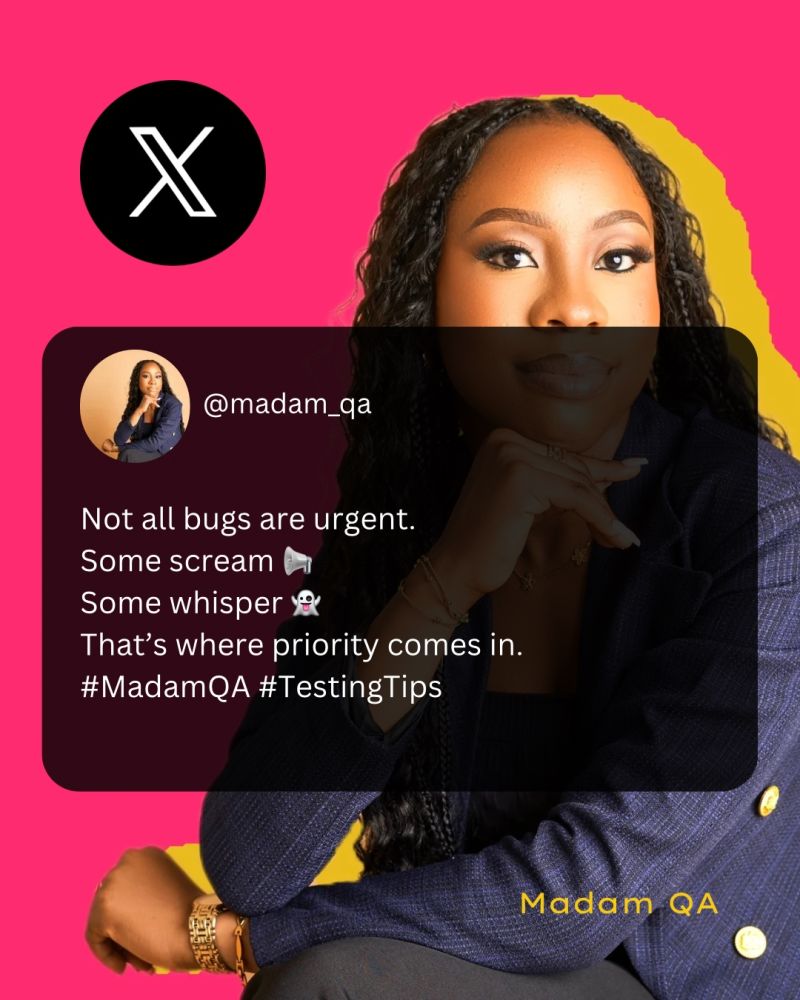
QA engineer Matachi Ononuju aka MadamQA went from nutrition to software testing and never looked back. She breaks down the pivot, the community that saved her, and why quality assurance deserves a seat at every table.
When you think about tech, you probably picture developers typing furiously or product managers with colour-coded roadmaps. You probably don't picture someone who once spent their days thinking about macros and meal plans. But that's exactly where Matachi started, and where she definitely isn't anymore.
Today, Matachi Ononuju is a Software Quality Assurance Engineer at Bridge, a digital trade platform helping buyers and suppliers connect across borders. She's also one of the more vocal advocates for QA in a tech landscape that still, honestly, underestimates it. Inside with CareerBuddy sat down with her to talk about the pivot, the community she found along the way, and why she thinks QA engineers are the unsung heroes of every app you've ever used.

Okay, let's start at the beginning. Nutrition to QA — how does that even happen?
Matachi: Honestly? Curiosity. I was scrolling through Twitter one day and saw a post about a bootcamp. I signed up for two tracks, product management and quality assurance, just to see. And somewhere in that process, I fell in love with QA. After the bootcamp, I kept going on my own: YouTube, free resources online, just figuring it out as I went.
Just like that? No grand plan?
Matachi: No grand plan at all. I think sometimes the best decisions aren't planned. You just follow what's pulling you. And QA kept pulling me.
For anyone who doesn't know, what do you actually do as a QA engineer?
Matachi: I describe it as being a gatekeeper. What we do is verify and validate applications. Verification is asking: does what's been built actually match what the business said it wanted to build? Validation is asking: does this product actually solve the user's problem?
People assume it's just clicking buttons and seeing what breaks. But there's so much more underneath that. Test case creation, bug management, understanding the software development lifecycle, all of it. We're making sure that what gets shipped is something people can actually use, and use well.
So QA engineers are basically the last line of defence before something embarrassing goes live.
Matachi: Exactly. Think about WhatsApp. If WhatsApp goes down today, traders lose their communication channels, businesses lose deals. There's real-world impact behind every application that works, and behind every one that doesn't. That's what QA is protecting. We're not an afterthought. We're the safeguard.
You've been very vocal about QA being treated as an afterthought. Where does that come from?
Matachi: I've seen it happen too many times. QA gets brought in at the very end of a development cycle, after everything's been built, and then we're expected to catch all the problems. But by that point, you're not doing quality assurance anymore. You're doing risk management. Those are very different things.
I try to reach startup founders, product teams, businesses at early stages, before the bad habits set in. If you build QA into your process from the start, you end up with a better product and a smoother team. If you don't, you end up with expensive fixes and frustrated users.
Let's talk about the hard part. Were there moments where you thought, "I've made a huge mistake"?
Matachi: Yes. Early on, the hardest thing was finding people to learn with. A lot of my friends who were also transitioning into tech went into product management, project management, or software development. Barely anyone was going into QA. Even in my QA bootcamp track, most of the people there were software engineers who just wanted the extra knowledge. I felt like I was on my own island.
What got you through that?
Matachi: Community. I was on LinkedIn one day, and I spend a lot of time on the streets of LinkedIn, and I saw a webinar where Abiola Rasaq was speaking about QA. I followed her, kept showing up, kept asking to be let into the community she was building. That community became everything. Having people who understood the learning curve, who you could reach out to at any hour, that changed things for me.
That community is the Bug Detectives, founded by Abiola in 2021. We bridge the learning gap. Free webinars, free cohorts for beginners, mentorship. It's a QA home, a place where people at every stage of the journey can actually get the support they need, not just be told to "find a mentor" and left to figure it out.
You mentioned developers. QA engineers and developers can have a complicated relationship. How do you navigate that?
Matachi: It took me time to figure this out, honestly. Early on, I had clashes, not because my reports were wrong, but because of how I was communicating them. I'd send a perfectly detailed bug report and still get friction. Eventually I learned that how you frame feedback matters just as much as the feedback itself.
I started framing things as questions or suggestions rather than declarations. Not "this is broken" but "this doesn't seem to be meeting the expected behaviour. Can we look at how we might improve this?" It sounds like a small shift, but it completely changes the tone of the conversation. Developers are people too. Nobody wants to feel like their work is being torn down. You want them to feel like you're both on the same side, solving a problem together, not pointing fingers.
The goal is to separate the bug from the person's ego. The issue isn't that they failed. The issue is that the product isn't meeting expectations yet. Let's fix the product together.
You've worked across some very different industries, gaming, fintech, health, and now trade. Does QA actually transfer that cleanly?
Matachi: That's one of the things I love most about QA. It makes you a chameleon. The core skills, understanding user needs, verifying that a product does what it says it'll do, communicating problems clearly, those don't change based on the industry. What changes is the context, and that's actually exciting to learn.
I once wrote an article about being a QA chameleon. The point was that this field gives you adaptability that's rare. I've worked with marketers, engineers, product managers, and direct stakeholders. A good QA engineer ends up touching every part of an organisation. In a way, you become a jack of all trades, and you understand the whole system better than almost anyone else on the team.
What's something in QA right now that genuinely excites you?
Matachi: The intersection of QA and AI. Everyone's talking about AI taking jobs, but I think the real question is: how do we make QA even more valuable because of AI? AI-generated code still needs to be tested. AI systems still have edge cases, biases, failures. If anything, the need for QA engineers who understand both the technical and human side of things is only going up.
I'm also thinking about how to use AI to make QA processes faster, test generation, documentation, exploratory testing support. It's not about AI replacing the engineer. It's about the engineer using AI as a tool to go deeper and faster than before.
So you're evolving with it rather than running from it.
Matachi: That's exactly it. I want to be someone who helps define what QA looks like in this new era, not someone who got left behind because they refused to adapt.
If someone's thinking about going into QA, where do they start?
Matachi: First, understand the foundations. Before you worry about automation tools or writing scripts, you need to know why QA exists. Learn manual testing. Understand test case creation, bug reporting, the software development lifecycle. Think of it like learning to walk before you run. Then ride the bike. Then, yes, eventually drive the car, but do it in that order.
Second, find your people. Find a study group, a community, a cohort. Mentors are great, but mentors are busy. What really helps is having a circle of people at the same stage as you, people you can message at midnight when something doesn't make sense. That community will carry you through the parts where you feel like giving up.
Last question. What's the one thing every QA engineer should never forget?
Matachi: That we are advocates for the user. Everything else, the test cases, the bug reports, the automation scripts, it's all in service of making sure that the person who opens that app has a good experience. When we do our jobs well, users don't even know we existed. And that's okay. The app just works. That's the goal.
Matachi Ononuju is a QA Engineer at Bridge and a team member at Bug Detectives, a community built to support QA engineers at every stage of their journey. You can find her on LinkedIn, where, by her own admission, she spends a lot of time.