    Why 53% of Small Businesses in Nigeria Don't Use Software

    Anizoba Divine builds software for businesses in Anambra. He explains why owners in the Southeast resist digital systems and how he sells them anyway.

    Reviewed by Oluwadamilola Koya · September 24, 2026

    Published in Divine Anizoba

    Building digital systems for businesses that have never written down what they are

    Jump to
    Why 53% of Small Businesses in Nigeria Don't Use Software
    Illustration · CareerBuddy

    Anizoba Divine is a software engineer and the founder of Ashlines Global, a technology and creative services firm based in Anambra State.

    Most of his clients are small and medium enterprises (SMEs) in Southeast Nigeria, making the transition from paper records and single-phone operations for the first time. We asked him what building software for local businesses actually involves.

    Key Data Point: SME Digital Adoption in Nigeria

    The Numbers: According to a 2023 National Bureau of Statistics (NBS) survey cited by Gazette Nigeria, only 47% of Nigerian SMEs have adopted basic digital tools for their daily business operations. The remaining 53% operate entirely on paper logbooks, phone calls, and WhatsApp messages.

    Diagnostic Overview: SME Digital Landscape in Southeast Nigeria
    [ ] High reliance on single-phone operations and manual notebooks.
    [ ] Absence of standardized digital operational procedures across major industries.
    [ ] Education and process mapping consume more project time than writing code.
    [ ] Local cultural alignment is required for technology adoption to succeed.
    [ ] Hotels and hospitality lead the region in mandatory software integration.


    Observing Before Building: The Reality of Tech Consulting

    Sometimes I walk into a business just to watch. I'm not there to pitch. I want to see how they take orders, who reports to whom, and what happens when a customer comes in and the owner isn't around. I do this before I ever sit down with the person who runs the place.

    I build digital systems for businesses in the Southeastern part of Nigeria. Websites, web apps, booking tools, whatever a business needs so it stops running everything through one phone and one notebook. And the part of the job that takes the most time has very little to do with code.

    Core Takeaway:
    The part of a software engineering job that takes the most time in traditional markets has very little to do with writing code.

    Why Small Businesses in Southeast Nigeria Resist Digital Systems

    Why don't small businesses in Southeast Nigeria use digital systems? Because nobody has told them they have to.

    For most business categories across the region, no [formal operational] standard exists yet. It remains a "do-it-anyhow-you-like" environment. Because those unstandardized businesses make up the vast majority, that informal approach becomes the prevailing industry mindset, especially in Anambra State.

    Primary Barriers to SME Digitization:
    1. Absence of enforced industry standards across traditional sectors.
    2. Unclear organizational structure and undefined brand identity.
    3. Lack of documented operational processes before attempting tech integration.
    

    • The other reason is that a lot of owners have never thought about what their business is. When I meet an organisation, the first thing I want to know is:

      how they're structured,

    • what their relationships look like inside, and

    • what their core values are, if they've ever written any down.

    All of that has to go into whatever I build.

    Customization Over Generic Templates

    They need to open the system and see themselves inside it, instead of a random generic system.

    Their language should be in there. Their colours. The way they actually do things, not the way a template assumes a business does things. If a hotel handles reservations a certain way, the booking system I build should follow that.

    Here, people don't understand that yet. So I'm often sitting with someone who has never considered what their identity is or how their own business runs on paper, and before I can build anything, I have to teach. Sometimes you go to meet a client and end up giving them a lesson on things they should already know about their own organisation.

    I don't mind. I need people to understand these things so the way they do business gets better than it was. But it means education is a big chunk of every project, and you have to budget time for it.

    Which businesses in the Southeast have already gone digital?

    Hotels!

    Hotels and hospitality lead the shift. When someone builds a hotel in the Southeast now, they're already expecting to own a web app or some kind of system that lets people outside the state book and pay without being there. The hospitality market set that requirement. Anyone opening a hotel or a resort has to go digital whether they like it or not.

    Most businesses aren't hotels, though. For them, the standard hasn't been set, and that's where the challenge is.

    Why Do Tech Companies from Lagos Fail in The Southeast?

    Look at the fintechs. When OPay and the others started, the Southeast didn't take to them straight away. What happened was that people who had gone out to Lagos or wherever saw how well it worked, came back and started using it. People here watched them use it without hiccups and followed. Now the fintechs don't have much trouble in the Southeast. Unless you're new. If you're new, you still have to break in, and it's a tough game out here.

    Regional Expansion Strategy:
    Do not try to force Southeast businesses to adapt to rigid corporate principles. 
    Adapt your software principles to fit existing regional behavior.

    Most of the tech companies that dominate the Southeast now did not start in the Southeast.

    Some came in and 'died' here, then went back home because they didn't understand the culture. Whatever location you're in, you need to understand what that location demands and how the people there think.

    I'm not trying to change how the Southeast behaves. You can't. If you try, it'll take years, and you'll spend them convincing people to adapt to your principles instead of building anything. So I do it the other way: I make my principles fit the way people here behave. I keep my standards. I just build them in a form these people can use, where they can see the need for it themselves.

    Your immediate environment is your first market.

    Unless you have the resources for a national or worldwide launch, you're building for the people around you. Build it to fit where you're going to release it.

    How to Sell Software to Traditional Business Owners (who have never thought about their brand)?

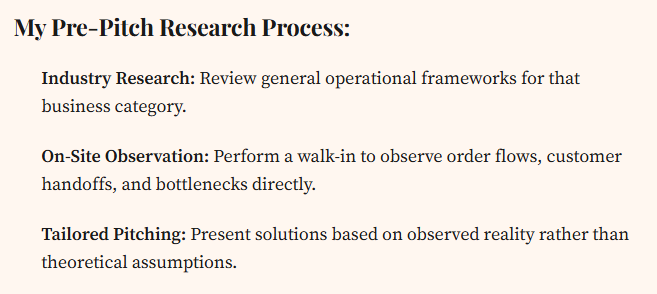
    You study them before you meet them. If you sit down with a business owner and you can't explain how a system should work for an organisation like theirs, you're going to mess up badly, and you will never convince that person again.

    So I read up first. General knowledge of how businesses in that category run. Then the walk-in, just to watch the process. By the time I'm across the table from the owner, I'm not speaking from assumption. I've been there. I've seen how they operate. It's a lot easier to convince someone when you're speaking from that knowledge.

    Divine's process

    Is it still hard? Yes. You can do all of this, and they'll still not listen. What can you do? One thing I've settled on is to solve the small problems first, the ones a business can feel, and let the bigger systems come after.

    What should new software engineers in Nigeria focus on?

    For anyone going into software engineering, or looking for somewhere to work, I'll say this.

    • I see software engineering as a route, not the destination. The destination is a product. People want to see what you've built, not what you can do.

    Software engineering is not the destination. The destination is a product.

    Engineering Reality Check:
    Software code is the vehicle; a problem-solving product is the destination. 
    In the era of AI and automated dev tools, creators who build products survive.
    • Engineers who treat coding as the sole objective face growing frustration. Employers no longer hire developers purely for raw technical tasks the way they used to, as AI tools handle basic execution.

    • People who treat software-building as the destination are going to get frustrated, and it's getting worse in this era. People no longer hire software guys the way they used to. Whatever they wanted to hire you for, especially the learned ones, they can do a lot of it now without you.

    • So you need an idea. Something you're going to build, or something the people around you need and will pay you for. That's where the market is now. The people who'll stay relevant in this period are the ones who can create.

    • And creativity isn't an AI thing, which is another mistake people make. Creativity is in the small things you do. If you can look at a small thing and make something out of it, you're fine. If you can't, you already have a problem in this industry

    • Be someone who reads. Be someone who sits down to think. Study your environment so you know what's needed in it. Pay attention to conversations, to trends, to what's happening elsewhere in the world.

    • Don't be the reactive guy. Be in front, so when an opportunity comes up, you're the one standing there to solve it. The project I'm currently working on now, I didn't apply for it. Someone I met said, "Can we meet on such-and-such?" I still don't know how they knew what I do. We met, and the project is almost done. I've built a system that supports what they're doing.

    Be someone who generates ideas, and the world will find you.

    The world meets you when you're ready. You just have to know how to solve problems, so that when people meet you, you're not stammering.


    Meta title (59 chars): Why Nigerian Small Businesses Still Don't Use Software


    Meta description (152 chars):


    Slug: /mavens/why-small-businesses-nigeria-dont-use-software

    Related: The African Freelancer's Operating Manual: How to Build a Side Hustle That Actually Pays (2026)

    Related: Managing Up in Nigerian Companies: How to Get Your Oga to Actually Listen (2026)

    Advertisement

    Advertisement

    In-Article Ad

    Native ad placement

    Divine Anizoba

    Written by

    Divine Anizoba

    Anizoba Divine is a software engineer, administrator and educator based in Anambra State, and the founder of Ashlines Global, a technology and creative services firm focused on web and software development, branding, technology education and digital solutions for businesses and organisations. His experience spans software development, education, administration, technical writing and organisational operations, which is why his work with a new client starts with how the organisation runs, not with the code.

    View all articles →
    Ultimate CV Template for African Tech Roles
    Free Download

    Ultimate CV Template for African Tech Roles

    ATS-friendly CV template designed for tech jobs in Lagos, Nairobi, Cape Town, and remote positions.

    Get this on WhatsApp

    Join the CareerBuddy WhatsApp Group for daily career, salary, and AI-at-work intel for African professionals. Free, two taps.

    Discussion

    Sign in or create a free CareerBuddy account to join the discussion. Comments are moderated; abusive posts are removed.

    No comments yet. Be the first — set the tone.