The Cost of Employment in Nigeria: The Contractor Shift

    Nigerian firms are reclassifying full-time staff as "independent contractors" to dodge soaring employment costs. Is this genius or a ticking legal time bomb?

    Reviewed by Oluwadamilola Koya · June 18, 2026

    Jump to
    The Cost of Employment in Nigeria: The Contractor Shift
    Illustration · CareerBuddy

    The Retainer Trap: How Nigerian Corporations Are Using the "Independent Contractor" Loophole to Slash Benefits

    Faced with soaring statutory costs and aggressive wage enforcement, a growing number of corporate entities are opting out of employment entirely. Is it a masterclass in business survival, or a ticking legal timebomb? By CareerBuddy Media

    The memo arrives quietly, usually framed as a "strategic restructuring" or an "agility alignment." But across Nigeria's tech hubs, financial services, and creative agencies, the operational result is identical: full-time staff members are being called into boardrooms, handed termination letters, and simultaneously offered their exact same roles back—effective the following Monday—as Independent Contractors.

    The math behind this corporate shift is simple and unforgiving. In 2026, keeping a standard, full-time employee on a Nigerian payroll is no longer just about the base salary. Between mandatory 10% PenCom employer matches, 1% NSITF employee compensation levies, group life insurance mandates, and mounting payroll taxes, the overhead cost of official employment has skyrocketed.

    By reclassifying workers as "retainers," "freelancers," or "service providers," companies are wiping these statutory liabilities clean off their balance sheets. But as the line between independent vendor and exploited worker blurs, a massive philosophical and legal war is brewing between corporate finance teams, anxious HR departments, and vulnerable talent.

    The True Cost of a Full-Time Employee: The Balance Sheet Breakdown

    To understand why companies are exploiting this loophole, one must look at the hidden costs built into a traditional employment contract. For an employee with a gross monthly salary of ₦500,000, a company's actual monthly cash outflow is significantly higher.

    The statutory math breaks down as follows:

    Monthly Cost of Employment (CoE) Breakdown In 2026
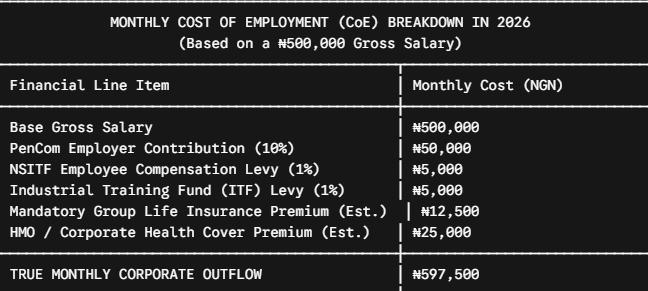
    MONTHLY COST OF EMPLOYMENT (CoE) BREAKDOWN IN 2026


    When an organization factors in these figures, the non-salary payroll burden sits at an additional 19.5% minimum. In sectors requiring robust risk provisions, secondary benefits, or localized allowances (such as transport subsidies mandated to offset fuel pricing), the actual corporate overhead easily reaches 35% to 43% above the headline salary.

    By changing that worker's status to an "Independent Contractor on a ₦500,000 Flat Retainer," the company instantly saves up to ₦97,500 per month per employee. Across a mid-sized enterprise of 100 workers, that single administrative adjustment keeps nearly ₦117 million in annual cash flow within the business.

    “It’s Corporate Disguise to Avoid the Law”

    Yinka*, an employment attorney who frequently represents aggrieved professionals at the National Industrial Court of Nigeria (NICN), argues that these balance-sheet gymnastics are an explicit violation of labor protections.

    "Let’s discard the polite corporate buzzwords like 'flexible talent architecture' or 'gig-economy optimization,'" Yinka states flatly. "Under Section 91 of the Nigerian Labour Act, the court looks entirely at the substance of the relationship, not the label on the contract. If an individual uses a corporate email address, reports to your office, relies on your equipment, and works under your exclusive control for 40 hours a week, they are legally an employee."

    Yinka warns that companies are creating massive, deferred liabilities for themselves.

    "Organizations think they are saving money on healthcare and pensions today. What they are actually doing is stacking up combustible legal risk. The National Industrial Court has repeatedly ruled against employee misclassification. When a disgruntled 'contractor' sues, the court can compel the company to backpay all withheld PenCom remittances, accumulated leave allowances, and statutory benefits, alongside punitive damages."

    “Look at the Macroeconomics: It’s This or Total Insolvency”

    From the executive suite, the perspective is driven by basic economic survival. Tolani, a Chief Financial Officer for a mid-sized logistics and infrastructure firm, explains that the contractor model is an emergency valve in a volatile market.

    "Ethical commentators love to criticize from a distance, but they do not manage corporate cash flow," Tolani counters. "With the National Minimum Wage Act setting a rigid baseline of ₦70,000, and the new progressive income tax bands scaling rapidly up to 25% for top earners under the current tax code, our payroll compression is severe. If we maintain every single support staff member on full-time benefit plans, our operational costs will outpace our margins. We would have to shut down operations."
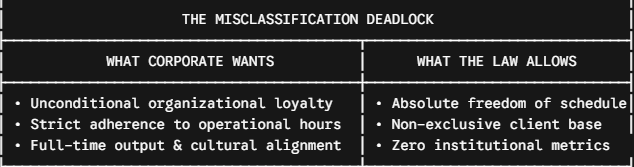

    For Tolani, the contractor model is a compromise that keeps businesses running while preserving livelihood opportunities:

    • Converting Fixed Costs to Variable Costs: It allows companies to convert fixed, immovable payroll structures into variable operational expenses that can scale dynamically with market demand.

    • Talent Autonomy: It technically allows professionals to bypass exclusivity clauses, freeing them to service multiple corporate clients simultaneously to outpace inflation.

    The HR Paradox: Demanding Loyalty Without Providing Security

    The widespread shift to retainer contracts has left Human Resource leaders in a difficult position, forced to maintain workplace productivity while stripped of traditional corporate incentives.

    Funmi, a senior HR director, outlines the cultural erosion this model introduces:

    "You cannot have your cake and eat it," Funmi warns. "When you strip a worker of job security, medical cover, and a pension plan, you also strip the organization of its management leverage. I routinely see line managers furious because a 'contractor' refuses to log into communication lines by 8:00 AM or declines to attend mandatory corporate culture exercises. But legally, you cannot dictate work hours or enforce organizational culture on an independent vendor."

     THE MISCLASSIFICATION DEADLOCK

    Because businesses want the absolute control of a traditional employer but the zero-liability profile of a vendor, teams are fracturing. Contractors give transactional output for transactional status, and overall organizational efficiency drops.

    The Impending Regulatory Crackdown

    The long-term viability of the contractor loophole is also facing headwinds from state and federal revenue bodies. Under the new Tax Administration frameworks, regulatory agencies are tracking payroll data anomalies closely.

    Ngozi, a corporate governance and compliance auditor, notes that the sudden drop-offs in corporate remittances are triggering automated audits. "When a company's filings show its official PAYE staff strength plummet from 120 down to 20 within two quarters, while its gross banking turnover remains unchanged or grows, it triggers an immediate tax audit. The government relies heavily on PAYE revenue and PenCom capital pools to stabilize the broader economy. They will not let billions of Naira slip into the untaxed contractor vacuum indefinitely."

    Under the updated tax administration provisions, firms found guilty of intentional payroll misclassification face back-taxes alongside severe non-compliance penalties: ₦100,000 for the initial month of violation and ₦50,000 for each subsequent month per infraction.

    The High-Stakes Calculus: Who Loses What?

    • Founders & CFOs: Save immediate cash flow but accumulate severe, deferred legal liabilities at the National Industrial Court.

    • Operations Managers: Lose the administrative leverage required to enforce strict project timelines, daily deliverables, and team synchronization.

    • HR Managers: Face a cultural vacuum where building corporate loyalty, tracking performance metrics, and reducing churn becomes practically impossible.

    • Employees: Lose safety nets (HMO, PenCom) and bear the full brunt of macroeconomic inflation alone on a flat, unprotected retainer.

    The Verdict: Necessary Agility or Systemic Exploitation?

    For the thousands of mid-level professionals caught in the middle, the "retainer trap" feels less like independent freelancing and more like a regression in workplace rights.

    The debate remains deeply divided. The financial and executive camp maintains that talent and labor flexibility are absolute necessities to prevent mass corporate insolvencies in an inflationary economy. Conversely, legal practitioners and human resource strategists warn that building corporate longevity by eroding worker safety nets is a short-sighted strategy that will face intense regulatory and judicial blowback.

    As the cost of employment continues to climb, the boundary lines of the independent contractor loophole will remain the most hard-fought legal and financial battleground in the Nigerian corporate ecosystem.

    Related: Contract vs Permanent Jobs in Nigeria (2026): Which Should You Actually Take?

    Advertisement

    Advertisement

    In-Article Ad

    Native ad placement

    Salary Negotiation Playbook
    Free Download

    Salary Negotiation Playbook

    Proven strategies to negotiate your worth in African markets. Includes scripts and market data.

    Get this on WhatsApp

    Join the CareerBuddy WhatsApp Group for daily career, salary, and AI-at-work intel for African professionals. Free, two taps.

    More Stories You'll Love

    Discussion

    Sign in or create a free CareerBuddy account to join the discussion. Comments are moderated; abusive posts are removed.

    No comments yet. Be the first — set the tone.