Your Meetings Are Costing You Money. Here's the Fix

    Meetings draining your time & budget? Learn how to calculate the true cost of bad meetings and transform them into effective, decision-driven powerhouses.

    Reviewed by Oluwadamilola Koya · June 25, 2026

    Jump to
    Your Meetings Are Costing You Money. Here's the Fix
    Illustration · CareerBuddy

    How to Run Effective Corporate Meetings: The Anti-Waste Guide

    Useless corporate syncs drain company cash and kill employee morale. Learn how to calculate your calendar's true financial cost and fix your meetings.

    Let’s be entirely honest with ourselves: a staggering, indefensible percentage of the corporate meetings currently cluttering your daily digital calendar could have easily been resolved with a single, well-structured Slack message, a quick Loom recording, or a concise, bulleted email update.

    Yet, day after day, ambitious professionals and managers sit through circular, exhausting syncs that fracture their deep work windows, drain their cognitive capacity, and actively destroy company morale.

    According to Paul English, the legendary cofounder of Kayak, organizations completely underestimate just how expensive bad meeting culture truly is to their bottom line. It isn't just a minor administrative annoyance or an inevitable part of corporate life; it is one of the most overlooked drivers of operational friction, workplace fatigue, and baseline unproductivity in the modern corporate ecosystem.

    Drawing on the strict operational playbooks of hyper-effective global enterprises like Amazon, LinkedIn, Airbnb, and Shopify, English breaks down how leaders can transform draining syncs into clear, high-energy, decision-driven engines.

    meetings meetings meetings... when do they stop?

    The Real Mathematics of an Open Calendar

    When a manager or team lead mindlessly schedules a one-hour meeting with eight senior team members, they rarely look at the actual math behind that block of time. They view it as a simple, harmless "one-hour slot" on their Google Calendar. In reality, that is eight collective hours of high-level, specialized focus torn completely away from core execution. If that meeting features no clear agenda, no actionable decisions, and consists mostly of team members reading status update slides out loud while others check their phones, it represents a massive institutional deficit.

    To bring this reality home, let us look at the actual financial mathematics of a single corporate synchronization.

    To bring this reality home, let us look at the actual financial mathematics of a single corporate synchronization.

    Where n represents the number of attendees present in the room.. For example, if you assemble a cross-functional group of 8 senior operators, each averaging an internal cost of $50 per hour, for a 1.5-hour roadmap alignment sync, the formula renders:

    Where n represents the number of attendees present in the room.. For example, if you assemble a cross-functional group of 8 senior operators, each averaging an internal cost of $50 per hour, for a 1.5-hour roadmap alignment sync, the formula renders:

    If that block of time passes without a definitive strategic choice being made, your organization has literally burned $600 in liquid capital just to exchange verbal progress reports.

    The best companies in the world recognize that focused human time is a finite, completely unrecoverable resource. They do not treat meetings as a default mechanism for killing time, validating a manager's underlying performance anxiety, or making people feel included. They treat live meetings as a highly expensive tool reserved explicitly for creating absolute alignment, generating collective creative energy, and making definitive strategic choices that cannot be achieved asynchronously.

    The Three Golden Rules of Effective Syncs

    If you want to rescue your team's calendar, prevent employee burnout, and restore deep, uninterrupted focus to your workweek, you need to implement three non-negotiable structural rules across your organization:

    1. Ban the Presentation, Enforce the Pre-Read

    Never allow someone to spend 20 minutes sharing their screen just to read text or bullet points out loud that everyone in the room is perfectly capable of reading themselves. Shift entirely to the famous Amazon narrative model: the meeting host must write a concise, comprehensive text document beforehand and drop it directly into the calendar invite at least 24 hours prior.

    The meeting begins with 10 to 15 minutes of absolute, collective silence where everyone reads the document together and takes notes. The remaining live block is then dedicated 100% to rigorous cross-examination, debate, alignment, and choice-making.

    2. Identify the Single DRI (Directly Responsible Individual)

    If a meeting consists of a group of people collectively admiring an operational problem without anyone being explicitly responsible for the final call, it will inevitably end with the most expensive phrase in corporate communication: "Great discussion everyone, let's schedule a follow-up sync next week to finalize this."

    Every calendar invite must clearly designate a Directly Responsible Individual (DRI). The rest of the team is in the room to offer specialized data, unique perspectives, and healthy friction—but the DRI owns the execution of the final choice. If there is no DRI, there is no meeting.

    3. Protect the Deep Flow State via Structural Boundaries

    Implement organization-wide, unbreachable boundaries, such as "No-Meeting Wednesdays" or "Deep Work Mornings." Giving your engineers, writers, designers, and operators uninterrupted, completely predictable blocks of time to actually build things prevents the emotional exhaustion that comes from constant context-switching.

    If an employee is pulled into a status sync every 45 minutes, their brain never reaches the complex, deep mental state required to solve hard engineering or strategic problems.

    The Calendar Clean-Up Framework: A Step-by-Step Diagnostic

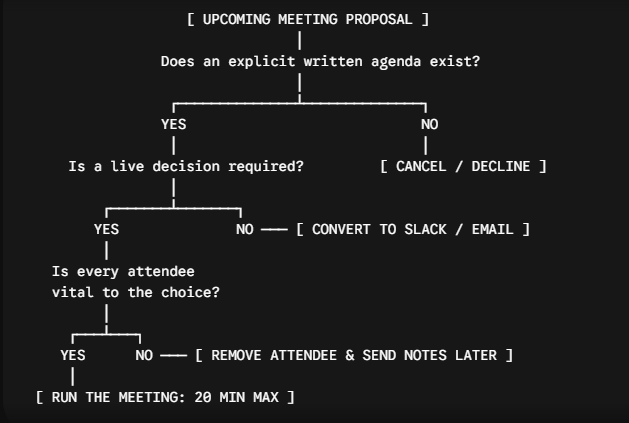
    Before you send out your next calendar invite—or before you click "Accept" on someone else's—run the meeting through this strict four-step diagnostic protocol. If it fails even one of these criteria, it should be removed or converted into an email:

    Before you send out your next calendar invite—or before you click "Accept" on someone else's—run the meeting through this strict four-step diagnostic protocol


    • The Objective Audit: Does this meeting have a clearly written, outcome-based agenda attached to the invite? (e.g., "Objective: Choose the Q3 email software vendor," not "Discussion about software"). If no outcome-based agenda exists, politely decline the meeting.

    • The Audience Audit: Is every single person on the invite list absolutely necessary for the decision to be made? If a team member is there simply to "stay in the loop" or "listen in," remove them immediately. Keep them in the loop by sending them the written meeting minutes or the recorded transcript afterward instead.

    • The Duration Audit: Why is the default meeting length across global software applications always set to 60 minutes? Challenge your team to slash meetings down to a default of 15 or 20 minutes. Short timelines create positive pressure; they force people to stop making small talk and get straight to the core data points.

    The Master Conclusion

    A great meeting should leave your team feeling lighter, clearer, more focused, and ready to sprint. If a scheduled calendar block does not have a defined objective, a clear decision-maker, and an explicit, undeniable need for live alignment—do your corporate culture a massive favor, save your company money, and cancel it.

    Related: How to Identify a High-Performing Employee in the First 3 Weeks

    Related: How to Pivot Into Tech From a Non-Tech Background in Nigeria (2026)

    Advertisement

    Advertisement

    In-Article Ad

    Native ad placement

    Ultimate CV Template for African Tech Roles
    Free Download

    Ultimate CV Template for African Tech Roles

    ATS-friendly CV template designed for tech jobs in Lagos, Nairobi, Cape Town, and remote positions.

    Get this on WhatsApp

    Join the CareerBuddy WhatsApp Group for daily career, salary, and AI-at-work intel for African professionals. Free, two taps.

    More Stories You'll Love

    Discussion

    Sign in or create a free CareerBuddy account to join the discussion. Comments are moderated; abusive posts are removed.

    No comments yet. Be the first — set the tone.