
    What Happened to the [Nigerian] LinkedIn Inbox

    A recruiter, a fraudster and a suitor now arrive in the same format. Inside the sorting problem eroding trust on the platform Nigerian careers run on.

    Reviewed by Oluwadamilola Koya · July 23, 2026

    Jump to
    What Happened to the [Nigerian] LinkedIn Inbox
    Illustration · CareerBuddy

    A recruiter, a fraudster, and a man who liked your profile picture now arrive in the same format. Sorting them is unpaid work, and not everybody pays the same amount.

    Ada opens LinkedIn at 7:40 on a Tuesday morning. Eleven new messages. She reads them the way you read a market; fast, looking for the one thing worth stopping for.

    A recruiter from a firm she has heard of, with a role that might be real. A recruiter from a firm she has not heard of, with a role that is almost certainly not. Somebody offering to grow her follower count. Somebody who wants to "discuss a partnership" and whose profile has forty-one connections and no posts. A man from a company she once tagged in a post, opening with a compliment about her energy. Two people selling a course. One selling crypto. A former colleague. A message that just says "Hi dear."

    By 7:52, she has replied to one and left the rest. That is twelve minutes of a working professional's morning spent doing quality control on a platform she needs, and none of it produced anything. She does it again tomorrow.

    "It isn't that the messages are difficult to read," she says. "It's the sorting. For every single one, you have to decide: is this work, is this fraud, or is this a man? And the only way to find out is to reply. Replying is how the fraud works."

    This is the part of the LinkedIn story that does not get written. Everybody has noticed the flirting. Fewer people have added up what it costs to sort it from everything else arriving in the same envelope.
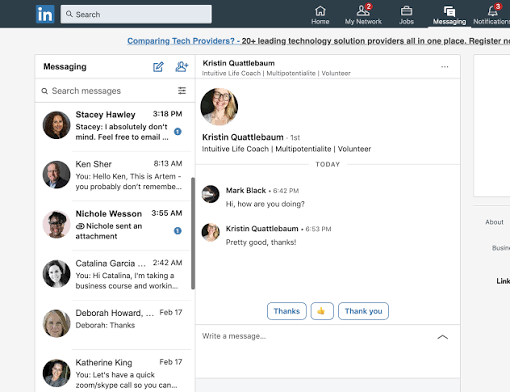
    LinkedIn inbox

    The Platform That Sold Trust

    To understand why so much lands in Nigerian inboxes, start with what LinkedIn is actually selling.

    Every other platform asks you to prove yourself. LinkedIn asks your employer to prove you. Real name, real title, real company, real education, real work history, sometimes a phone number. That architecture is the product. It is why a message from LinkedIn carries a weight that the same message on Instagram would not.

    It is also, as Nigerian recruiters have been saying for a while now, exactly what makes it worth attacking. Emmanuel Faith, who runs the Lagos human resources consultancy HR Clinic, told Rest of World that victims tend to believe LinkedIn offers because the platform is built on trust and professional credibility, and that profiles carry valuable detailed data — real names, emails, job titles, education, work history, sometimes even phone numbers — which makes it easy to personalise attacks.

    The economic conditions do the rest. Such scams thrive in countries like Nigeria, where high unemployment and a weak economy have pushed many young professionals to take risks, at times while ignoring obvious red flags, Faith said. "They want to believe it's real. That's what scammers count on." He added that as more Nigerians apply online or remotely, the attack surface is larger.

    The result is documented. BusinessDay reported this year that trust among Nigerian job seekers on LinkedIn appears to be steadily eroding, and that a platform once positioned as a gateway to career mobility is increasingly exploited as a low-barrier hunting ground for fraudsters who capitalise on economic uncertainty, local hiring norms, and persistent weaknesses in recruitment systems. The Nigerian pattern they identified is specific: credential theft amid acute unemployment, or account takeover.

    Busola, a 27-year-old Lagos philosophy graduate looking for digital marketing work, is the case both outlets reported. She was approached with an offer to earn cryptocurrency promoting products. "They told me to give them my login credentials so they could show me how their job flow works," she said. "I hesitated, but I was desperate, so I shared my details." By the following morning, she had lost access to her account, and it was being used to distribute fraudulent job referrals across her professional network.

    Read that last part slowly. The scam does not end with her. It converts her professional credibility into ammunition and fires it at everyone who trusted her. Her connections then receive a message from a real person they know, which is precisely the message that gets opened.

    Kunle, who works in fintech in Yaba and asked that his employer not be named, watched it happen from the other side. "One woman I studied with sent me a job link. Real woman, real profile, we did group work together for four years. I almost clicked on it!”. He didn't, only because the message had no greeting. "She doesn’t speak that way; not without a greeting anyway. That one saved me. But how many people will notice something that small?"

    The volume behind this is not small. LinkedIn identified and removed 80.6 million fake accounts at registration in the six months from July to December 2024 alone. That number is usually cited as proof the system works. But it also measures how many people are trying.

    The Other Kind of Message

    Layered on top of the fraud is something else entirely, and that is where the sorting gets genuinely hard.

    There is now real survey evidence on romantic use of LinkedIn. Zety's LinkedIn Romance Report, a nationally representative survey of 1,023 employees conducted in April 2026, found that 22 per cent of workers have used LinkedIn for romance. One in five had used it to research a potential romantic partner, and one in eight said they had formed a romantic relationship that started on the platform.

    The reason people give is the one that matters for Nigeria. Nearly half of respondents viewed information on LinkedIn as more trustworthy than what appears on traditional dating apps, with profile photos, bios, mutual connections, career paths, and education levels cited as the top factors sparking romantic interest.

    A second survey, by Resume.org in February 2026 covering 868 singles, found 28 per cent had used LinkedIn for dating-related purposes in the past year. Vetting was near-universal among that group: 92 per cent looked up someone's profile before a first date, 88 per cent looked up an ex or former romantic interest, and 88 per cent had directly messaged someone they were interested in dating through the platform.

    There is peer-reviewed work behind the pattern too. A 2025 study in Scientific Reports, analysing 331 LinkedIn users with dating intentions, found that perceived trustworthiness enhances perceived safety, which in turn fosters dating intent — users who regard LinkedIn profiles as credible experience a heightened sense of safety, which the authors describe as a prerequisite for contemplating alternative uses of the platform such as romantic pursuit.

    So the mechanism is not mysterious. The verification that makes LinkedIn useful for hiring makes it attractive for dating, and attractive for fraud, for the same reason. One design decision, three user groups, one inbox.

    Nigeria bears a striking resemblance to these numbers. Our review of public discussions on LinkedIn, X and Nairaland found the same themes recurring: fake recruiters, unsolicited romantic messages, aggressive sales pitches and genuine recruiters all competing for attention in the same inbox. Across dozens of public posts reviewed, users repeatedly described checking company pages, mutual connections and employment histories before responding to messages, while many women said networking conversations often shifted into personal or romantic territory. Recruiters, meanwhile, complained that candidates had become slower to respond because repeated scam attempts had made them suspicious of unsolicited outreach.

    Adaeze has turned that vetting into a routine she can recite.

    "Before I respond to anyone I haven't met, I check three things. The company page — does it have other employees, or is this person the entire organisation? Mutual connections — are they people I actually know? And the posting history. If an account has existed since 2019 and has never posted once, something is wrong."

    Four minutes per message, roughly. On an ordinary morning she has eleven. "It's work. Nobody is paying me for it. And I still get it wrong sometimes."

    Emeka, a product manager in Lekki, does the same checks and has noticed the approaches themselves getting better. "The old ones were easy — bad grammar, strange email, some Gmail address for a bank role. Now they reference a post I wrote last week. They know my previous employer. One of them congratulated me on a promotion that was real." He pauses. "That's when I started to worry. They're reading. The lazy ones filter themselves out; the ones left are the ones you can't spot."

    Who Pays the Sorting Cost

    Here is where the distribution stops being even.

    The Zety data found broad disapproval of romantic approaches: 74 per cent of surveyed workers said romantic advances on LinkedIn cross a professional line, and 65 per cent worried that dating via the platform could damage their professional reputation. But the disapproval is not evenly held. Men were more than twice as likely as women to consider the platform appropriate for dating purposes.

    Sit with that gap. The people most likely to think this is acceptable are not the people most likely to receive it.

    And reception is mixed in a way that complicates any tidy account. Among respondents, 34 per cent felt uncomfortable receiving romantic messages, 31 per cent were neutral depending on context, 19 per cent would block or report the sender, and 16 per cent felt flattered. Roughly half are not bothered. Roughly half are. The sender cannot tell which half he is writing to, and neither can the recipient until she opens it.

    That uncertainty is the cost. Not the individual message; most individual messages are survivable. The cost is that every message must now be classified before it can be answered, and the classification is unreliable. A message reading "I came across your profile and would love to connect about an opportunity" is a recruiter, a scammer, or a man, and you will not know which until you engage, and engaging is how the scam works.

    For women in Nigerian professional spaces, this compounds. The approach often arrives dressed as work — a partnership, a mentorship, a role — because that dressing is what gets a reply. Which means the false positives run both directions: real opportunities get ignored because they pattern-match to something else, and approaches get answered because they pattern-match to work.

    Blessing, a data analyst in Abuja, recognises the pattern immediately.

    "The difficulty is that it arrives dressed as work," she says. "Nobody opens with 'I like you.' It's 'I'd like to discuss a role,' or 'I'm putting a panel together, and I'd love you on it,' or 'Can I pick your brain?' So you take it seriously. You research the person, you draft a proper reply, you give it an hour. Then the actual message comes."

    She stopped responding to unknown men about eighteen months ago and can name what the policy has cost her. "A man messaged me about a consulting engagement. Real company, real budget. I left it for three weeks because it looked like everything else. By the time I replied, they'd given it to someone else."

    The defensive responses are predictable, and they all cost something. Profile photos changed to something less flattering. Headlines made vaguer. Location removed. Messages left unread for days. Connection requests from unknown men declined by default, which on a platform where opportunity travels through weak ties is a direct professional cost. Some women maintain an account they barely use, which on LinkedIn means an account that does not surface in recruiter searches.

    Which brings us full circle. Every one of those defences reduces visibility, and visibility is the entire product. The platform's value proposition is that being findable brings you work. The sorting problem pushes people toward being less findable.

    What It Does to Hiring

    For recruiters, this shows up as a number they cannot explain. 

    Tolu has recruited for Lagos technology companies for six years, mostly mid-level engineering and product roles. Her cold outreach response rate has fallen and she is confident it has nothing to do with the roles.

    "My message and a scam message are indistinguishable to someone who has already been burned twice," she says. "Same format. Same 'I came across your profile and thought of you.' I now lead with a link to the company's careers page before I've even introduced myself, just so the person can verify I exist."

    Response rates on cold outreach have fallen across the market, and the reason is not that candidates are uninterested. It is that a legitimate first message from a real recruiter at a real company is now formally indistinguishable from three other things arriving the same morning. Nigerian recruiters describe candidates who ignore genuine roles, who ask for verification before engaging, who route everything to email, who assume ghost listings.

    The scepticism is rational. BusinessDay's reporting found that job seekers pointed to outdated listings and a surge in scam outreach after applying for roles, and that some argued LinkedIn should require companies to confirm when roles are filled or paused, automatically flagging listings that linger without hiring activity. When a platform carries ghost jobs and real jobs in the same feed, treating everything as a ghost job is the lower-cost error.

    There is a cost on the employer side too, and it is not small: a company whose staff use company-branded profiles for personal approaches is exposing itself. The profile says the company name. The behaviour attaches to it.

    Tolu has watched that cost land on a client. "A candidate declined the interview. No complaint, no explanation, just said she wasn't interested. I found out later that a manager at that company had approached her personally, months earlier. She wasn't going to walk into that building.”

    There is a cost on the employer side too, and it is not small: a company whose staff use company-branded profiles for personal approaches is exposing itself. The profile says the company name. The behaviour attaches to it.

    The Part That Is Real

    None of this means the connections are fake.

    Some of them are the most useful relationships people have. The mentor who first appeared as a cold DM. The co-founder met in a comment section. The job that came through someone who followed your posts for a year before saying anything. Even marriages have come out of that inbox. Real ones.

    Now, over 60 per cent of adults have had a workplace romance, and 43 per cent married someone they worked with. People meet people where people are. Professionals are on LinkedIn. The arithmetic writes itself, and pretending otherwise is prudish.

    Ifeoma, who runs a small consultancy in Port Harcourt, is blunt about this. "My best client came from a cold message. Someone I had never met, no mutual connections, nothing. If I had applied the rules I now apply, I would have deleted it." Her closest professional friendship started the same way. "So I don't want anyone writing that all of this is danger. It isn't. It's just that I now have to do security work every morning before I can find the good ones."

    Chuka, who works in enterprise sales in Ikeja, sits on the other side of that. Cold outreach is his job. "I send messages to people who don't know me. That's the work. And the honest thing to say is that it has become harder to do it decently, because everything I write looks like something a fraudster would write." He has changed his approach entirely — no compliments, no pleasantries, company page linked in the first line. "It reads cold. But warm now reads as suspicious, and I would rather be boring than ignored."

    The problem was never the connection of people. It is that the channel [LinkedIn] carrying those connections is now also carrying industrial-scale fraud, and the recipient has to do the separation herself, every cycle, unpaid, with imperfect information and real consequences for guessing wrong.


    Which brings us to what is missing

    Nigeria has roughly 1.7 million graduates leaving universities and polytechnics every year into an economy that lacks the capacity to absorb them, and where informal employment stands at 93 per cent of total employment. Those graduates job-hunt on LinkedIn because there is nowhere else with the same reach. The platform they depend on has a functioning problem, and nobody in the market has put a number on it.

    Tolu, who has spent six years watching the pipeline from the recruiting side, finds that strange. "Everyone in my industry knows this is happening. We talk about it constantly. But when a client asks me why response rates dropped, I have nothing to show them. I have stories. Stories don't survive a board meeting."

    Adaeze will open the app again tomorrow at 7:40. She will sort eleven messages, answer one, and get on with her day, and no dataset anywhere will record that she did it.

    "Let them count it," she says. "I'll tell them exactly what's in my inbox."

    Related: What Recruiters Filter On Before They Ever Read Your Profile

    Advertisement

    Advertisement

    In-Article Ad

    Native ad placement

    Ultimate CV Template for African Tech Roles
    Free Download

    Ultimate CV Template for African Tech Roles

    ATS-friendly CV template designed for tech jobs in Lagos, Nairobi, Cape Town, and remote positions.

    Get this on WhatsApp

    Join the CareerBuddy WhatsApp Group for daily career, salary, and AI-at-work intel for African professionals. Free, two taps.

    More Stories You'll Love

    Discussion

    Sign in or create a free CareerBuddy account to join the discussion. Comments are moderated; abusive posts are removed.

    No comments yet. Be the first — set the tone.