—Oxford Research Says That's Not Always a Problem.
An Oxford professor reviewed 250 studies on workplace misconduct and found four distinct motives behind it; only one is actually a problem. Here's the script smart managers use to tell the difference before they discipline anyone.
When a workplace rule gets bypassed, a standard operating procedure gets completely ignored, or a mandatory compliance step is omitted in a fast-moving corporate environment, a manager's immediate, hardwired organizational instinct is to act fast. The traditional corporate playbook feels incredibly straightforward and comforting: identify the offender, issue a formal warning or a structured human resources query, enforce strict compliance, and move swiftly along.
But according to groundbreaking, exhaustive research from Michael J. Gill, an associate professor of organization studies at the University of Oxford’s Saïd Business School, taking a purely reactive, disciplinary approach to every single policy variance is a massive leadership blind spot.
After synthesizing and deeply reviewing more than 250 comprehensive studies spanning four decades of global corporate data, Gill revealed a complex, nuanced truth: workplace misconduct is rarely a simple, black-and-white issue of "good employees" versus "bad actors." People bypass company frameworks for entirely different reasons.
While some rule-breaking is undoubtedly toxic, careless, and self-serving, a significant, highly valuable portion of it is actually driven by your top-tier, highest-ownership employees simply trying to help your customers, support their overwhelmed colleagues, or save a critical project timeline from bureaucratic gridlock.
The Four Faces of Workplace Misconduct
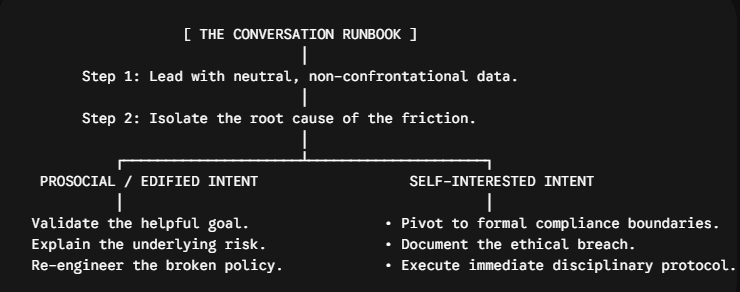
To manage a high-ownership, high-output team effectively without crushing morale, leaders must learn to look entirely past the immediate impact of a broken policy and accurately diagnose the intent that drove the behavior in the first place. Gill’s research breaks workplace rule-breaking down into four distinct, highly recognizable motivational quadrants:
1. Self-Interested Misconduct
This occurs when an employee bypasses a corporate rule purely for personal gain, individual convenience, or to shortcut personal accountability. Examples include falsifying an internal expense report, stealing company property, or cutting major ethical corners simply to artificially boost individual sales commissions or performance metrics. This quadrant requires swift, unambiguous, and absolute institutional discipline.
2. Prosocial Misconduct
This is where excellent employees frequently get caught. Prosocial rule-breaking occurs when an individual deliberately sidesteps an overly restrictive company policy specifically to actively help a customer or a colleague in a high-pressure situation. For example, an account manager might expedite an urgent product delivery for an upset, high-value client, even if it explicitly skips a slow, standard 3-day internal verification loop, simply to protect the company's client retention rate. The underlying intent is noble and business-centric, but the execution exposes the organization to unmanaged operational risk.
3. Corrupted Misconduct
This type of rule-breaking is driven directly by intense organizational pressure, unrealistic or impossible performance targets, or toxic systemic environments. When employees are handed impossible monthly sales quotas or unrealistic operational deadlines under the constant threat of termination or public humiliation, they are practically forced by the corporate architecture to cut corners, falsify tracking data, or look the other way just to survive.
4. Edified Misconduct
Encouraged and executed in the absolute name of doing the genuinely right thing for the long-term health of the business, where the existing official rule is recognized by the employee as completely broken, obsolete, or actively counter-productive. This happens when an agile software engineer uses an unauthorized, unapproved software tool to complete a critical client project because the company’s official IT procurement vendor takes three weeks to grant a basic user license, and waiting would mean missing the client's hard launch date.
Shifting from Penalty to Systematic Curiosity
If your default response as an executive or manager is to instantly penalize every single operational variance with equal severity, you inadvertently construct a restrictive culture of fear. Your team quickly learns that using personal judgment, taking initiative, or solving problems creatively is a dangerous professional liability.