
    Bolt CEO Ryan Breslow Fires HR Team: What It Actually Means

    Ryan Breslow fired Bolt’s entire HR department and replaced it with a small People Ops team. The internet loved the take. Was he wrong or right?

    Reviewed by Dami · June 3, 2026

    Jump to
    Bolt CEO Ryan Breslow Fires HR Team: What It Actually Means
    Illustration · CareerBuddy

    The CEO Who Fired His Entire HR Team Said the Problems Disappeared. He’s Not Entirely Wrong. He’s Not Entirely Right Either.

    Ryan Breslow’s decision to eliminate Bolt’s HR function generated more heat than analysis. The actual story is more instructive than either the cheerleaders or the critics tend to acknowledge.

    At Fortune’s Workforce Innovation Summit in May 2026, Ryan Breslow — the 31-year-old CEO of fintech company Bolt — said something that generated exactly the kind of viral engagement you would expect from a line delivered to a business audience at a conference.

    “We had an HR team, and that HR team was creating problems that didn’t exist.” He paused. “Those problems disappeared when I let them go.”

    The applause, the clips, and the takes followed immediately. The people who already thought HR was overreaching found confirmation in this chaos. The HR professionals who had been through something similar found provocation. The startup founders who had complex relationships with their own people functions found either vindication or concern, depending on their experience.

    The full story, which takes about ten more sentences to tell, is considerably more instructive than the line.

    •   •   •

    What Actually Happened at Bolt
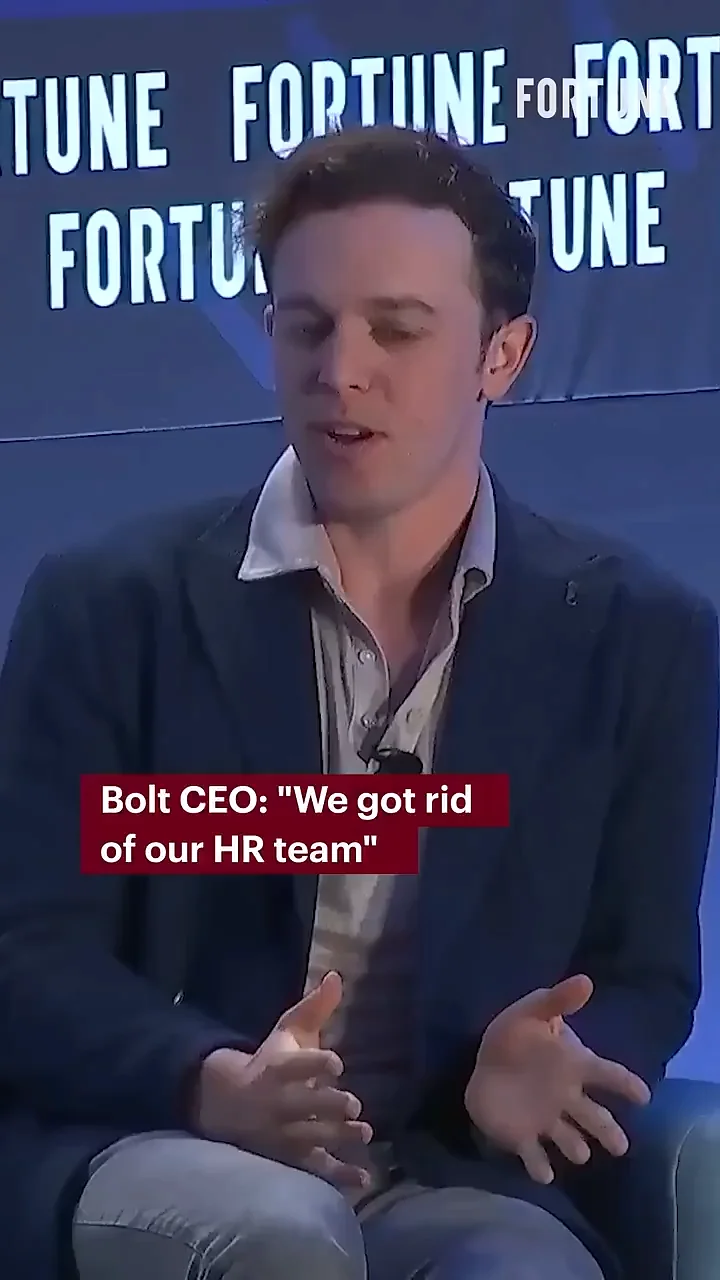
    Bolt CEO Breslow describes how he cut out the HR department for creating problems that didn't exist

    Bolt was founded in 2014 by Breslow in his Stanford dorm room. It grew into a significant player in online checkout technology, reached an $11 billion valuation in 2022, and then collapsed. By early 2025, with annual revenue at approximately $28 million against a valuation that had fallen to around $300 million — a 97 percent decline — Breslow returned as CEO with board approval. The company he came back to was in what he described as ‘wartime.’

    Bolt CEO Ryan Breslow fired the company’s entire HR team because they were “creating problems that didn’t exist.”
    by u/eternviking in whoathatsinteresting

    He cut approximately 30 percent of the workforce. He eliminated the HR department entirely and replaced it with a small people operations team focused on onboarding, training, and basic administrative support. He told employees they had 60 days to adapt to a significantly leaner culture. He later said 99 percent couldn’t make the shift. Bolt now operates with around 100 employees, down from thousands.

    The context matters because ‘CEO fires HR team’ reads very differently when it is ‘CEO of company that lost 97 percent of its value fires HR team as part of radical restructuring to survive’ versus ‘CEO of healthy company fires HR team because he doesn’t believe in HR.’ These are different situations, and they produce different conclusions.

    •   •   •

    The Part That Is Actually True

    Breslow’s observation that some HR teams create problems rather than solve them is not wrong. It is a recognizable organizational failure mode.

    HR functions at companies in growth phases can develop a kind of institutional momentum; building processes, policies, and structures that made sense at one stage of the company’s development and persist past their usefulness. The policy that made sense at 500 people may be bureaucratic overhead at 50. The investigation process designed for a mature organization may be disproportionate for a startup. The culture programs built during peacetime may be misaligned with what a company in genuine crisis needs to survive.

    There is also a real failure mode where HR becomes the function that manages organizational tension by absorbing it into process rather than resolving it. Complaints that generate extensive documentation but no change. Investigations that take weeks and produce nothing actionable. Programs that create the appearance of addressing problems without addressing them. Breslow’s specific framing — that problems disappeared when the HR team did — is more likely to mean that the HR processes that had been generating activity around certain tensions were removed, and with them the activity. Whether the underlying tensions were also removed is a different question.

    •   •   •

    The Part That Is Not the Full Story

    People operations, the structure Breslow says he replaced HR with, is described as focused on onboarding, training, and serving as an employee resource. This is, as multiple HR professionals noted immediately, a description of HR with a rebrand and a reduced scope. The functions Breslow eliminated, employee relations, policy management, compliance, investigations, and organizational development, simply did not just disappear. They either moved somewhere else or stopped being done.

    At 100 employees, some of those functions genuinely do not need dedicated headcount. But some of them; compliance with employment law, proper documentation of terminations, and clear processes for addressing misconduct are not optional regardless of company size. They are not optional because they protect employees. They are also not optional because they protect the company from the legal exposure that comes with not having done them.

    Bolt’s situation is also specific in ways that limit how transferable the lesson is. A company that has cut 97 percent of its value, reduced its headcount from thousands to a hundred, and is operating in recovery mode has a different HR requirement than a company at a different stage. The organizational complexity that requires a full HR function was also reduced in the restructuring. He did not just fire the HR team. He fired most of the company.

    •   •   •

    What the Nigerian Startup Context Adds

    The Bolt story is being discussed in Nigerian startup circles with the specific energy of people who have had complicated experiences with HR functions at local companies. The response is recognizable: some founders who built HR teams because they thought they should have, found them bureaucratic, and are now reconsidering. Some employees who have been through Nigerian HR processes that protected the organization rather than them are reading Breslow’s comments with feeling.

    The Nigerian context has specific features worth naming. HR functions in Nigerian organizations often operate in a high power-distance culture where challenging upward is difficult, where the function’s ability to genuinely advocate for employees against management is constrained, and where the gap between the HR policy that exists on paper and the practice that actually governs the workplace can be significant. In that context, HR that primarily serves organizational compliance rather than employee experience is not a startup-specific problem. It is a structural one.

    The more useful question for Nigerian founders and operators is not whether to have HR, but what you actually want your people function to do: protect the organization, develop your people, resolve conflict, or some combination of these, and whether the function you have is built to do the thing you actually need.

    •   •   •

    Breslow’s line is memorable because it is clean and provocative and confirms a widely held frustration. The full story is messier, more context-dependent, and more interesting.

    The actual lesson is not ‘fire your HR team.’ It is that people functions need to be built for the stage and size of the company they serve, need to spend more time solving problems than documenting them, and need honest evaluation when the organization changes. That lesson applies whether you have fifty employees or five thousand.

    The problems that disappeared when he let the HR team go were real. Whether the problems that tend to appear later — when there is no clear process, no documentation, no neutral party — were also considered is the part of the story the conference clip does not tell you.

    Related: HOW TO BUILD AND MAINTAIN GOOD WORK RELATIONSHIPS

    Advertisement

    Advertisement

    In-Article Ad

    Native ad placement

    Ultimate CV Template for African Tech Roles
    Free Download

    Ultimate CV Template for African Tech Roles

    ATS-friendly CV template designed for tech jobs in Lagos, Nairobi, Cape Town, and remote positions.

    Get this on WhatsApp

    Join the CareerBuddy WhatsApp Group for daily career, salary, and AI-at-work intel for African professionals. Free, two taps.

    More Stories You'll Love

    Discussion

    Sign in or create a free CareerBuddy account to join the discussion. Comments are moderated; abusive posts are removed.

    No comments yet. Be the first — set the tone.