What Is a Forward Deployed Engineer? Cost & How to Hire

    Learn what a forward deployed engineer does, 2026 salary benchmarks, and how to hire top African FDEs in 4 to 7 days with CareerBuddy.

    Reviewed by Oluwadamilola Koya · October 21, 2026

    Jump to
    What Is a Forward Deployed Engineer? Cost & How to Hire
    Illustration · CareerBuddy

    What is a Forward Deployed engineer, and how do you hire one?

    In May, OpenAI launched a company whose whole product is engineers who go and work inside other companies. The OpenAI Deployment Company started with more than $4 billion behind it and a deal to buy Tomoro, a UK consultancy, for its roughly 150 forward deployed engineers. Days earlier, Anthropic's backers had put $1.5 billion into a venture built on the same idea. In July, Amazon Web Services set up a forward deployed engineering team of its own.

    So if you're a founder or CTO trying to hire one forward deployed engineer this quarter, those are the companies bidding against you. Paraform, a US recruiting firm that places these engineers, tells clients to budget 8 to 12 weeks for the search. Plenty of teams don't have 12 weeks, because the enterprise deal that needs the engineer will have closed or died by then.

    CareerBuddy keeps a pre-vetted network of US-based forward deployed engineers ready for on-site and hybrid deployment. If you need one, book a call, and we'll send a shortlist matched to your (stack, location, and travel) requirements within 4 to 7 days. If you're still deciding whether you need one at all, everything below is what we tell clients on that first call.

    What does a forward deployed engineer do?

    A forward deployed engineer (FDE) is a software engineer who works inside a customer's environment and writes production code to make a product work on that customer's real data, systems, and processes. They sit in the customer's Slack, standups, and codebase, and sometimes in their office.

    Palantir invented the title. It sent engineers to sit with government and enterprise clients, and until 2016 it employed more FDEs than regular software engineers, according to The Pragmatic Engineer.

    In AI, the job usually starts after a demo goes well. The base model works, but turning a prototype into a production-ready LLM deployment requires real engineering. Someone has to build custom agent pipelines, connect them to a 15-year-old core banking system, navigate an undocumented authentication layer, and prove to a compliance team that every API call is secure. That person is the FDE.

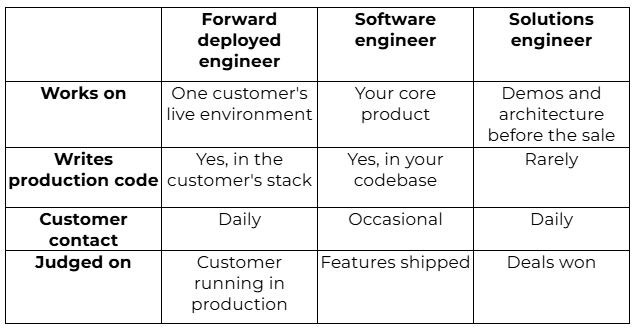
    Here's how the role compares with the two jobs it gets confused with:
    Forward deployed engineer vs Software engineer vs Solutions engineer
    • A forward deployed engineer works in one customer's live environment, writes production code in that customer's stack, deals with the customer daily, and is judged on whether the customer ends up running in production.

    • A software engineer works on your core product, writes production code in your own codebase, deals with customers occasionally, and is judged on the features they ship.

    • A solutions engineer works on demos and architecture before the sale, rarely writes production code, deals with customers daily, and is judged on deals won.

    The title is also splintering, which matters when you go looking for candidates. Perspective AI went through about 1,000 FDE job posts and found the same job listed as Forward Deployed AI Engineer, Applied AI Engineer and Deployment Solutions Engineer. By its estimate, roughly a third of the market sits under those other titles.

    Why demand for forward deployed engineers jumped in 2026
    Why demand for forward deployed engineers jumped in 2026
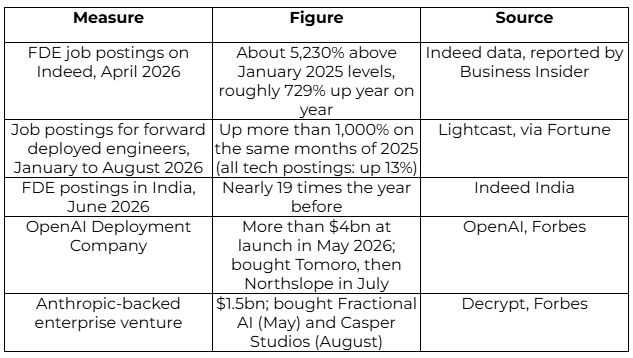
    • FDE job postings on Indeed in April 2026 were about 5,230% above January 2025 levels, roughly 729% up year on year (Indeed data, reported by Business Insider).

    • Job postings for forward deployed engineers from January to August 2026 were up more than 1,000% on the same months of 2025, against 13% for all tech postings (Lightcast, via Fortune).

    • FDE postings in India in June 2026 were nearly 19 times the year before (Indeed India).

    • The OpenAI Deployment Company launched in May 2026 with more than $4 billion, bought Tomoro, then bought Northslope in July (OpenAI, Forbes).

    • An Anthropic-backed enterprise venture raised $1.5 billion and bought Fractional AI in May and Casper Studios in August (Decrypt, Forbes).

    The money is chasing a plain problem: AI pilots stall at the point where they have to touch real systems. S&P Global's 2025 research found that the share of companies abandoning most of their AI initiatives before production rose from 17% to 42%.

    Here's what that looks like up close. Gritmind, a software firm in Kaunas, Lithuania, described an invoice-validation project to Forbes in September. The client's staff decided whether an invoice was valid using what they knew about vendor contracts and past transactions, and most of that knowledge wasn't written down anywhere. An AI agent can't follow a rule nobody wrote. Someone has to sit with the accounts team, find the rules, turn them into code, and decide which calls stay with a person. That's FDE work, whatever the job title says.

    Why forward deployed engineers are hard to hire

    The first problem is the skill mix. You need someone who ships production code and can also hold a room with a sceptical IT director. Paraform is blunt about this in its guidance to clients: most strong backend engineers have no interest in customer-facing work, and most consultants who are good with clients can't ship production systems. The people who can do both are a small group, and the AI labs are calling them first.

    The second is price.

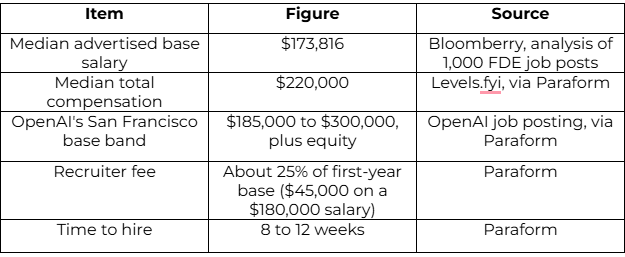
    Here's what a US hire looks like in 2026:
    Price/ hiring costs
    • Median advertised base salary: $173,816 (Bloomberry, analysis of 1,000 FDE job posts)

    • Median total compensation: $220,000 (Levels.fyi)

    • OpenAI's San Francisco base band: $185,000 to $300,000, plus equity (OpenAI job posting, via Paraform)

    • Recruiter fee: about 25% of first-year base, or $45,000 on a $180,000 salary (Paraform)

    • Time to hire: 8 to 12 weeks (Paraform)

    The third is the interview. Most companies run their standard software engineering loop, which tests algorithms and system design in a vacuum. It passes people who'd hate sitting with customers and fails people who'd be excellent at it. Paraform also says the most common reason an FDE search drags is that the hiring team never agreed which kind of FDE it wanted.

    How to hire a forward deployed engineer, step by step

    1. Check that you need one. First Round Review has reported that founders who come asking for an FDE often turn out to need a software engineer or a post-sales hire. The clearest sign you do need one: an enterprise proof of concept has stalled on integration, and pulling your core product engineers onto it would stall your roadmap.
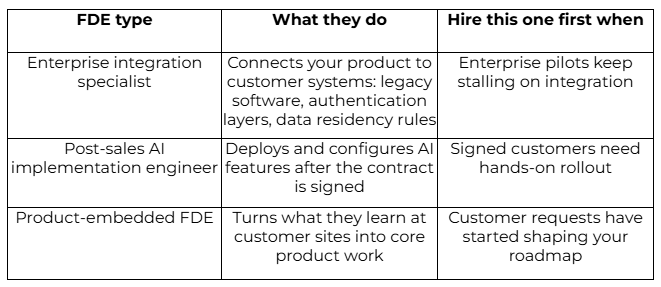

  1. Pick which kind of FDE you're hiring. Paraform splits the role three ways:

  2. three kinds of FDE
    • Enterprise Integration Specialist: Connects your product to customer legacy software, authentication layers, and data residency rules. Hire this one first when enterprise pilots keep stalling on technical integration.

    • Post-Sales AI Implementation Engineer: Deploys and configures custom AI agents and models after the contract is signed. Hire this one first when signed customers need hands-on rollout.

    • Product-Embedded FDE: Turns what they learn at customer sites into core product improvements. Hire this one first when customer requests start shaping your primary roadmap.

  3. Write travel and on-site expectations into the job description upfront. Specify how many days a week or month are required at customer offices, target metro areas, and travel expectations. Undisclosed travel requirements are one of the top reasons FDE offers fall apart at the final offer stage.

  4. Search past the job title. Ramp has written that 7 of its 16 FDEs are former founders. Other strong hunting grounds include solutions architects who still ship code, engineers from technical consulting practices, and enterprise backend engineers used to complex integrations.

  5. Test both halves of the job. Run one practical round where they build against a messy, real-looking system (thin docs, odd authentication, dirty data). Run a scoping round where you hand them a vague customer brief and ask what they'd build first and what they'd refuse to build. Then ask: How would you explain a failed deployment to a non-technical executive?

  6. Keep the interview loop short. Top US FDE candidates hold multiple offers. Aim for first call to offer in two to three weeks.

  7. Sourcing US On-Site FDE Talent: Managing Location & Travel Constraints

    Most enterprise FDE roles in the US are not fully remote. Because enterprise clients in banking, healthcare, defense, and retail demand strict security compliance, FDEs frequently spend 2 to 4 days a week on-site at client headquarters in major tech hubs like San Francisco, New York, Austin, Chicago, and Seattle.

    When sourcing US-based FDEs, your hiring strategy must account for three critical location factors:

    1. Regional Metro Matching: Sourcing engineers located within commuting distance of major client density reduces travel overhead and burnout.

    2. Clear Per-Diem & Travel Terms: High-performing candidates expect clear company policy regarding travel coverage, hotel stipends, and flexible work arrangements for non-travel weeks.

    3. Rapid Onsite Vetting: Finding engineers who already hold required industry certifications, security clearances, or experience in air-gapped systems saves weeks during enterprise onboarding.

    Hire forward deployed engineers through CareerBuddy

    CareerBuddy is a specialized recruitment partner helping growth-stage tech companies and enterprise AI firms staff critical engineering roles fast. We maintain a pre-vetted network of US-based forward deployed engineers available for on-site, hybrid, and full-time placement.

    1. You book a call, and we pin down the FDE type, your stack, time zones and any on-site needs.

    2. We send a shortlist matched to those requirements within 4 to 7 days.

    3. You interview, pick who to hire, and we handle the placement.

    We work to your hiring model, whether that's contract, contract-to-hire or full-time. You can pay a percentage of salary once a hire is made, so you pay nothing if no placement happens, or agree a one-off flat fee or retainer if you'd rather fix the cost up front.

    Book a call to hire a forward deployed engineer

    Forward deployed engineer FAQs

    What is a forward deployed AI engineer?

    A forward deployed AI engineer is a forward deployed engineer who specialises in getting large language models and AI agents working inside a customer's workflows. Google, Scale AI and Cohere use the title. The work is the same as any FDE's (scoping, integration, deployment), with more time spent on prompts, evaluation and guardrails.

    How much does it cost to hire a forward deployed engineer?

    In the US, the median advertised base salary is about $174,000 (Bloomberry) and median total compensation is about $220,000 (Levels.fyi). AI labs pay more: OpenAI advertises $185,000 to $300,000 base in San Francisco. Recruiters usually add a fee of around 25% of first-year base. Through CareerBuddy, you either pay a percentage of salary after a successful hire or a flat fee agreed up front.

    How long does it take to hire a forward deployed engineer?

    US recruiters such as Paraform tell clients to budget 8 to 12 weeks for a full search, and slow interview loops or a vague role definition stretch that further. Through CareerBuddy's vetted pool, you get a shortlist matched to your requirements within 4 to 7 days.

    What is the difference between a forward deployed engineer and a solutions engineer?

    A solutions engineer designs and demos systems, usually before a deal closes, and rarely writes production code. A forward deployed engineer builds and ships production code inside the customer's environment, mostly after the deal, and is judged on whether the customer ends up running in production.

    Can a forward deployed engineer work remotely?

    Often, yes. Many FDEs work embedded in the customer's Slack, code repositories, and standups, and travel only for kick-offs or the hardest phases of a rollout. Roles that need several days a week on-site are better filled locally, so state the on-site requirement in the job description.

    How does CareerBuddy help companies hire US-based FDEs?

    CareerBuddy provides a fast, specialized sourcing service for US-based forward deployed engineers. We match companies with pre-vetted candidates who fit exact technical stack requirements, travel expectations, and US metropolitan locations within 4 to 7 days. Book a call.


    Related: Women in tech: How to transition to tech roles in 2025

    Advertisement

    Advertisement

    In-Article Ad

    Native ad placement

    Ultimate CV Template for African Tech Roles
    Free Download

    Ultimate CV Template for African Tech Roles

    ATS-friendly CV template designed for tech jobs in Lagos, Nairobi, Cape Town, and remote positions.

    Get this on WhatsApp

    Join the CareerBuddy WhatsApp Group for daily career, salary, and AI-at-work intel for African professionals. Free, two taps.

    Discussion

    Sign in or create a free CareerBuddy account to join the discussion. Comments are moderated; abusive posts are removed.

    No comments yet. Be the first — set the tone.