We always hear about horrible bosses; those managers from hell who make every workday a living nightmare. But what about horrible employees and co-workers? Truth is, a toxic colleague can be just as bad (or even worse) because you’re stuck in the trenches with them daily.
In fact, a recent survey found “lazy co-workers” to be the number-one workplace pet peeve for 47% of employees, followed closely by co-workers with bad attitudes (42%). Clearly, dealing with difficult colleagues is a common frustration, yet many companies simply tolerate them.
So, we asked Nigerian professionals to share the most unhinged co-worker stories they’ve seen or heard. The responses ranged from unbelievable backstabbing to downright dangerous behaviour. (Of course, names have been changed for anonymity).
Buckle up for some workplace horror stories, and be glad these people aren’t on your team!
What Are the Signs of a Toxic Co-Worker?
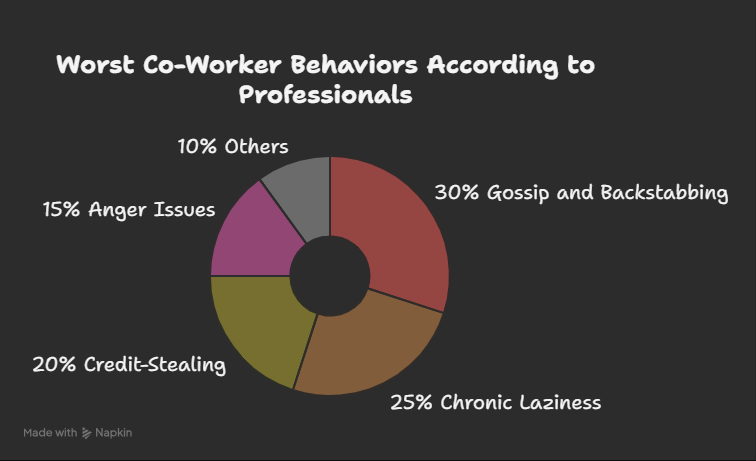
We did a quick poll of 50 professionals about co-workers from hell, and here’s what they said were the worst offences:
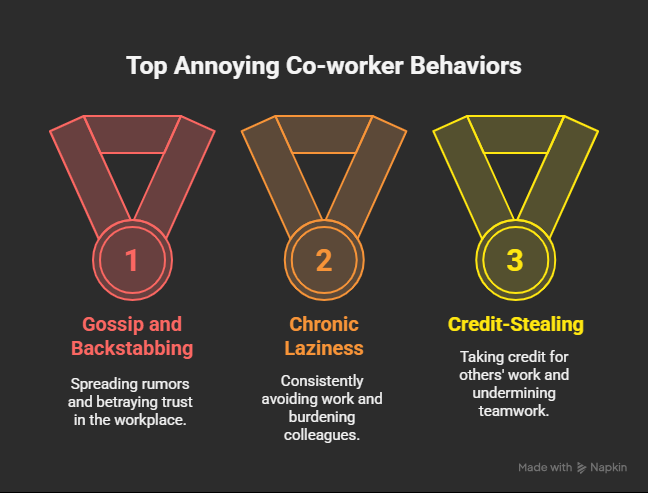
Gossip and Backstabbing – 30%: Spreading rumors, office politics, and betraying colleagues’ trust topped the list.
Chronic Laziness – 25%: Never pulling their weight and leaving others to pick up the slack.
Credit-Stealing – 20%: Taking praise for others’ work (and sometimes throwing teammates under the bus).
Anger Issues – 15%: Explosive tempers, bullying, or creating a hostile environment.
Others – 10%: From constant whining to inappropriate conduct, there’s plenty more that can make a co-worker “the worst.”
As you’ll see in the stories below, a truly horrible co-worker might check more than one of these boxes. Let’s dive into the wildest tales our respondents shared.
Et Tu, Co-Worker?
A Real Bad Employee Example

For Ada, a customer service rep at a Lagos financial services company, a friendly colleague turned into her worst nightmare. What started as an office friendship quickly revealed a two-faced agenda. Ada shares: “When I joined the company, Bisi was the first person to guide me. She was so friendly; showed me around, had lunch with me in our cafeteria [so I wouldn’t be alone] . I thought I’d made a work bestie.”
It didn’t take long for things to go sideways. Ada started noticing that private conversations somehow made it to management. “I vented to Bisi once about a tough client call. The next day, my manager called me in and oddly repeated things I had only told Bisi. That’s when I realized she’d been reporting my every complaint,” Ada says. Initially, Ada brushed it off as a misunderstanding, but then bigger red flags emerged.
Bisi began taking credit for work that Ada had done. In team meetings, she would enthusiastically present solutions that Ada had come up with in private. “I was shocked. We worked on a report together, but Bisi positioned it like all the ideas were hers. I didn’t want to seem petty, so I kept quiet,” Ada recalls. The final straw came during a major client project. Ada discovered an error in the data and fixed it late at night. The next morning, Bisi emailed the correction to everyone, cc’ing the CEO; without Ada’s name on it. “She basically stole my thunder and made me look inactive on a project I essentially saved,” Ada says, still incredulous.
Eventually, the truth unravelled. Another co-worker caught Bisi in a lie (she overheard Bisi badmouthing Ada to their boss with an exaggerated story). HR got involved, and multiple people came forward about Bisi’s gossip and backstabbing. In the end, Bisi was let go. “I felt bad that it came to her termination, but honestly, the team became so much healthier after she left,” Ada admits. The experience taught her a hard lesson about trust in the workplace. “Now I’m friendly with colleagues, but I keep sensitive things to myself until I truly know who I’m dealing with,” she says.
The Great Pretender
Fake Pregnancy Office Drama

Not all nightmare colleagues are openly hostile; some are master manipulators. Frank, an operations analyst in Abuja, recalls the most bizarre co-worker story he’s ever encountered. “We had this colleague, Yasmine, who faked an entire pregnancy to get out of work. I kid you not. It was the most unhinged thing I’ve seen,” he says.
It started innocently enough: Yasmine announced she was expecting a baby. The office was abuzz with congratulations and even arranged a small baby shower. Frank and others offered to lighten Yasmine’s workload. “We felt bad whenever she looked tired. We’d say, ‘Go home early, we got you.’ Our team lead even exempted her from the intense parts of a project, worried about her health,” Frank explains. But over time, some eagle-eyed colleagues noticed something was off. Yasmine’s baby bump never seemed to grow. Months passed with minimal physical change. She also would make contradicting remarks; one week saying she’s five months along, and a couple of weeks later claiming she’s seven months pregnant.
Suspicion grew, and HR discreetly asked for a doctor’s note to arrange her maternity leave benefits. That’s when Yasmine’s story crumbled. “She panicked and said she’d had a miscarriage, via our group text, to everyone, late one night,” Frank recounts. The office was flooded with sympathy messages the next day, but something didn’t add up. HR, aware of the inconsistencies, gently probed further. Pressured, Yasmine confessed that there was never a pregnancy. She had fabricated the whole thing to avoid a heavy workload and get some paid time off.
The revelation left everyone stunned (and angry). “I couldn’t believe someone would go that far,” Frank says. Yasmine resigned shortly after, amid the disgrace. The team was left picking up the pieces of projects she had sidestepped. “It was frustrating because we all worked extra to cover for her. Finding out it was under false pretenses? That broke the trust in our team for a while,” Frank notes.
The silver lining? The episode became a cautionary tale at the company about integrity. Now, Frank’s company rigorously verifies any extended leave requests. “We still empathize with genuine needs,” he adds, “but fool me once, you know…”
The Office Hothead
Dealing with a Toxic Colleague

Sometimes the horror in a co-worker story comes from explosive anger that turns a workplace into a war zone. Pascal, a project engineer in Port Harcourt, recounts dealing with a colleague whose temper was legendary. “If you said ‘good morning’ the wrong way, Alli would bite your head off,” Pascal says. What started as minor hotheadedness escalated over time into a truly volatile situation.
Alli was technically skilled, which is why management overlooked his behavior at first. But his interactions were laden with hostility. “He’d yell during meetings, slam doors, even throw staplers when he was mad. We all walked on eggshells around him,” Pascal recalls. The breaking point came during a deadline crunch. A teammate, fed up with Alli’s constant berating, challenged him to calm down. Alli completely lost it. He stood up, swept his arm across a desk, and sent a computer crashing to the floor. Then, in the stunned silence, he proceeded to hurl insults at everyone, including the manager.
“It was chaos. Half the team was in shock, the other half just ran out of the room,” Pascal says. HR was immediately called. According to Pascal, security had to escort Alli out before he did more damage. The aftermath was messy. Alli was terminated the same day, and the team had to stomach the emotional fallout. “People were shaken. It’s one thing to have a loud colleague, but when it gets physically destructive, you start fearing for your safety,” Pascal says.
In the weeks after, the company brought in a counselor to talk to the team and instituted a zero-tolerance policy for workplace violence or harassment. For Pascal, it was a tough lesson in how one person’s unchecked anger can poison an entire environment. “Looking back, we all wished we had reported his smaller outbursts earlier. Maybe it wouldn’t have gotten to that extreme,” he reflects.
The Flood Fiasco
When A Senior Colleague Is A Nightmare

An African proverb says “A child shall learn wisdom and get understanding if he sits beside the elders”. But what if a senior colleague, meant to be the wise elder, is after your life? Kunle, a digital marketer in Lagos, shared this harrowing experience: “It was a Monday morning downpour. My entire street was so flooded (for context, I’m 6’4” and the water was up to my thighs). I literally couldn’t leave my compound.” Kunle sent his immediate superior (let’s call her Ms. Aisha) videos of the raging flood, explaining that he was stranded and would need to work from home. He assumed any reasonable manager would understand. He was wrong.
Ms. Aisha accused him of making excuses. Not only did she blast Kunle on WhatsApp, she went as far as emailing HR and CC’ing him, claiming he was being unserious and using the weather as a cover for laziness. “She even dug up an old message where I’d taken a sick day weeks before, as ‘evidence’ that I was unreliable,” Kunle says. Next thing he knew, a senior colleague called, basically warning that if Kunle didn’t show up, his job might be on the line. “My boss got the guy who referred me to the company to call my mum! I was so embarrassed and furious,” he recalls.
Feeling he had no choice, Kunle braved the flood. He waded out and managed to catch a bus, soaked from the waist down. In the chaos, he missed a step and fell into an open gutter submerged under the floodwater. “It was disgusting and scary. I had cuts on my legs, my clothes were a mess. Thank God my laptop bag was waterproof,” he laughs darkly. Still, Kunle kept going until he reached the office, dripping wet and bleeding. Only then did Ms. Aisha seem alarmed, not out of concern for his well-being, but because she realised his showing up in such a state made her look bad to others.
Kunle changed into whatever spare clothes he could find and finished the workday in pain. There was never an apology from the boss. However, karma had its day. A few months later, Ms. Aisha announced she was leaving the company. “The day she sent that email, I literally opened a bottle of red wine at my desk. I’ve never celebrated someone’s exit like that,” Kunle admits.
How to Handle Toxic Co-Workers

These jaw-dropping stories highlight just how toxic a workplace can become thanks to one person’s outrageous behaviour. Horrible co-workers (and bosses) aren’t just an inconvenience; they can drain morale, hurt productivity, and even endanger people. What can you do if you find yourself stuck with someone like this?
First, trust your instincts. If a colleague consistently makes your life miserable, document the incidents and don’t be afraid to speak up. Yet, it turns out most people don’t report or confront toxic peers. One survey found that only 18% of employees complained to management about a colleague “making their life hell,” and just 24% confronted the individual directly. A full 54% simply tried to ignore the problem, hoping it would go away. The consequence of staying silent is that bad behaviour often escalates.
Of course, reporting a co-worker isn’t easy, and, as some of our stories show, management doesn’t always act. Nearly 41% of people who spoke up felt their leaders failed to address the toxic colleague. If you have a supportive HR or manager, involve them early, as they can mediate or take action. If you don’t, you might need to set firm boundaries with the person yourself, or in extreme cases, consider whether the company’s culture is the right fit for you. Your health and safety at work should never be compromised.
Our Insights: A healthy workplace culture is one that refuses to tolerate toxic behaviour, no matter who it’s coming from. Companies should proactively address issues (ideally before computers get flung or employees fake pregnancies). Hiring for cultural fit is key, as well as bringing in people with the skills AND the right attitude.
🔗Where CareerBuddy Fits In
These stories might make you laugh (or cringe), but they also highlight a serious truth: a bad hire or unchecked toxic behaviour can cost a company time, morale, and reputation. That’s why at CareerBuddy, we don’t just focus on filling roles: we help companies find the right people to elevate teams and strengthen cultures.
Whether it’s employer branding that attracts top talent, content storytelling that showcases your company culture, or hiring solutions that ensure a better cultural fit, we work with businesses across Africa to ensure stories like these don’t happen in your organisation.
If your team is ready to move beyond “survival mode” and start building a workplace that people love being part of, let’s talk.
➡ Book a free consult to explore our B2B services.
❓ FAQs
How do you deal with a toxic colleague at work?
Dealing with a toxic colleague starts with setting boundaries, documenting incidents, and speaking to your manager or HR. If the behavior doesn’t stop, it may be necessary to consider switching teams or employers for your well-being.
What are the signs of a toxic co-worker?
Signs include constant gossip, manipulative behavior, credit-stealing, chronic laziness, explosive anger, and creating a hostile work environment.
What impact does a bad co-worker have on the team?
A bad co-worker can lower morale, reduce productivity, increase staff turnover, and damage a company’s culture if not addressed quickly.