
    HR Burnout or Bad Job? 3 Experts Weigh In on a Common Issue

    Feeling burnt out or in the wrong career? 3 experts weigh in on an HR pro's dilemma, offering insights for every exhausted professional.

    Jump to
    HR Burnout or Bad Job? 3 Experts Weigh In on a Common Issue
    Illustration · CareerBuddy

    An HR Professional With Five Years of Experience Is Questioning Everything. Three Experts Respond. There Is a Lot Here for the Rest of Us.

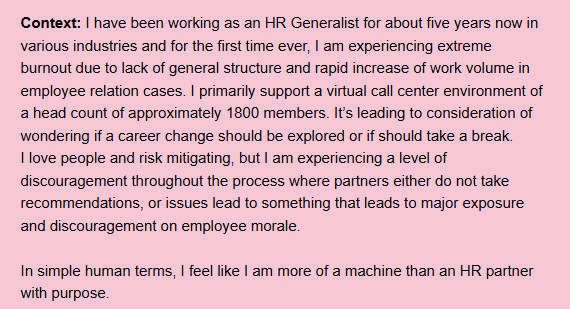
    An HR Generalist with five years of experience described reaching a wall; the kind of sustained exhaustion that makes you question whether the work itself is the problem.
    how do you know if it's burnout or you're actually not fit for the job?

    She had been in the role long enough to know the difference between this and a typical temporary block. She was supporting a virtual call centre of approximately 1,800 employees and thus dealing with a rapid increase in employee relations cases while structural support failed to keep pace. She was also watching her recommendations be ignored, issues escalate past the point where her advice could have prevented them, and the cycle repeat.

    "In simple human terms," she wrote, "I feel like I am more of a machine than an HR partner with purpose."

    Three senior professionals responded. Their answers shed light on her situation, and describe patterns that tend to start much earlier than year five. The professional who understands these patterns now will be better equipped to avoid them later.

    On the Question of Whether It Is You or the Job

    Christine McCallum-Randalls, Director of People at Test Double, made an observation that is simple and worth sitting with:

    "Since you were able to say why you feel the way you do, it seems like deep down you think the problem is burnout at this company."

    This is an important distinction. Burnout is a category that encompasses many different conditions, and interventions vary depending on which one you are experiencing. Burnout from doing work you fundamentally do not want to be doing requires a different response than burnout from doing work you love inside a system that consistently undercuts it. The first is a direction problem. The second is an environment problem.

    McCallum-Randalls pointed out that people can only absorb being consistently ignored for so long; and that when ignoring your advice repeatedly produces exactly the problems you warned against, the erosion of motivation is predictable and not a personal failing. "I've been there," she said, "and changing jobs is what helped me."

    She also raised the harder question: is there something about how recommendations are being delivered that could change how they land? This is not the same as saying the problem is with her. It is acknowledging that the political work of getting good advice implemented in organisations that are resistant to it is its own skill, and one worth developing. But it has limits. Some organisations are simply not structured to make use of good HR counsel, and continuing to provide it in the hope that this time will be different is its own form of self-erosion.

    Burnout Has Flavours. Diagnosis Requires Honesty.

    Cassandra Babilya, creator of Make Work Suck Less, offered a diagnostic framework that extends well beyond HR. She asked a series of questions worth applying to almost any career plateau: Would a different kind of role within the same field feel more energising? Is the problem primarily a leadership one — and if leadership changed tomorrow, would most of what you are feeling go away? What can you do now to stop allowing work outcomes to drain your emotional bandwidth?

    That last question is the one most people find hardest to engage with, because it requires a kind of detachment that runs counter to caring about your work. If you are doing work that matters to you, the outcomes feel personal. Learning to separate your professional identity from the outcomes you cannot fully control is not a form of not caring. It is a survival skill. And it takes time to develop, which is why it is worth starting before you are already exhausted.

    Babilya also raised the possibility of a real break. Not just a spa day, but a genuine pause in the pace. This is difficult to take seriously until you are already depleted, which is exactly when it becomes most necessary. Worth noting for people who are not yet there: the decision to take a break before you need one is almost always easier than deciding to take one after.

    Perspective Is the First Tool. The Rest Comes After.

    Sondra Norris, Founder of Strategic Culture Partners, brought in a longer view. Her coaching advice went back to the fundamental question of why this person entered HR in the first place and what the last five years had taught her about the difference between what she thought the work would be and what it actually is.

    She made a point worth sitting with: the partners who are not acting on recommendations are probably also stuck in a version of the "why bother" mindset. Discouragement is contagious in struggling organisations. When a team or a leadership group has stopped believing that things can change, the people whose job it is to drive change absorb that environment. It does not mean the change professional is wrong. It means the conditions for change are not currently present, and that is a different problem than the one that can be solved by working harder.

    Norris also raised the portability of HR skills to other fields; something worth knowing in advance rather than discovering in a moment of crisis. Most competencies developed in HR are transferable: analytical thinking, communication, conflict resolution, organisational design, data interpretation, and change management. What is not transferable is the domain-specific credibility that comes from seniority in a field. Moving into a new area often means starting at a lower level than your current title, not because your skills don't transfer, but because the new context has not yet seen them in action. This is a trade-off worth making in some circumstances and not in others. Knowing it exists is useful.

    What This Means if You Are Earlier in Your Career

    The post described a situation that developed over five years. But the conditions that made it likely started much earlier: in choices about which organisation to join, which role to take, and how the function was positioned within the company.

    The questions worth asking before year five are the hardest to answer honestly during a hiring process, but they're worth asking anyway. How does this organisation actually make decisions about people? Is HR a strategic partner in those decisions or a compliance function that is consulted after the direction has been set? What happens when HR makes a recommendation that leadership does not want to hear? Can you speak to someone on the team who has been there for more than two years about what the role actually looks like day-to-day?

    The feeling of being more machine than partner does not always start at year five. Sometimes it is the structure you walked into on day one, and the years between are the period during which the erosion accumulates slowly enough that it is hard to see in real time.

    Asking better questions at the front end does not guarantee anything. Organisations change. Structures shift. People who seemed like good leaders become something different under pressure.

    But it raises the probability of landing somewhere that is worth the work — which, at the beginning of a career, is worth a great deal.


    This post was inspired by the January 23rd edition of the I Hate It Here newsletter edited by Hebba Youssef

    Advertisement

    Advertisement

    In-Article Ad

    Native ad placement

    Ultimate CV Template for African Tech Roles
    Free Download

    Ultimate CV Template for African Tech Roles

    ATS-friendly CV template designed for tech jobs in Lagos, Nairobi, Cape Town, and remote positions.

    Get this on WhatsApp

    Join the CareerBuddy WhatsApp Group for daily career, salary, and AI-at-work intel for African professionals. Free, two taps.

    More Stories You'll Love

    Discussion

    Sign in or create a free CareerBuddy account to join the discussion. Comments are moderated; abusive posts are removed.

    No comments yet. Be the first — set the tone.