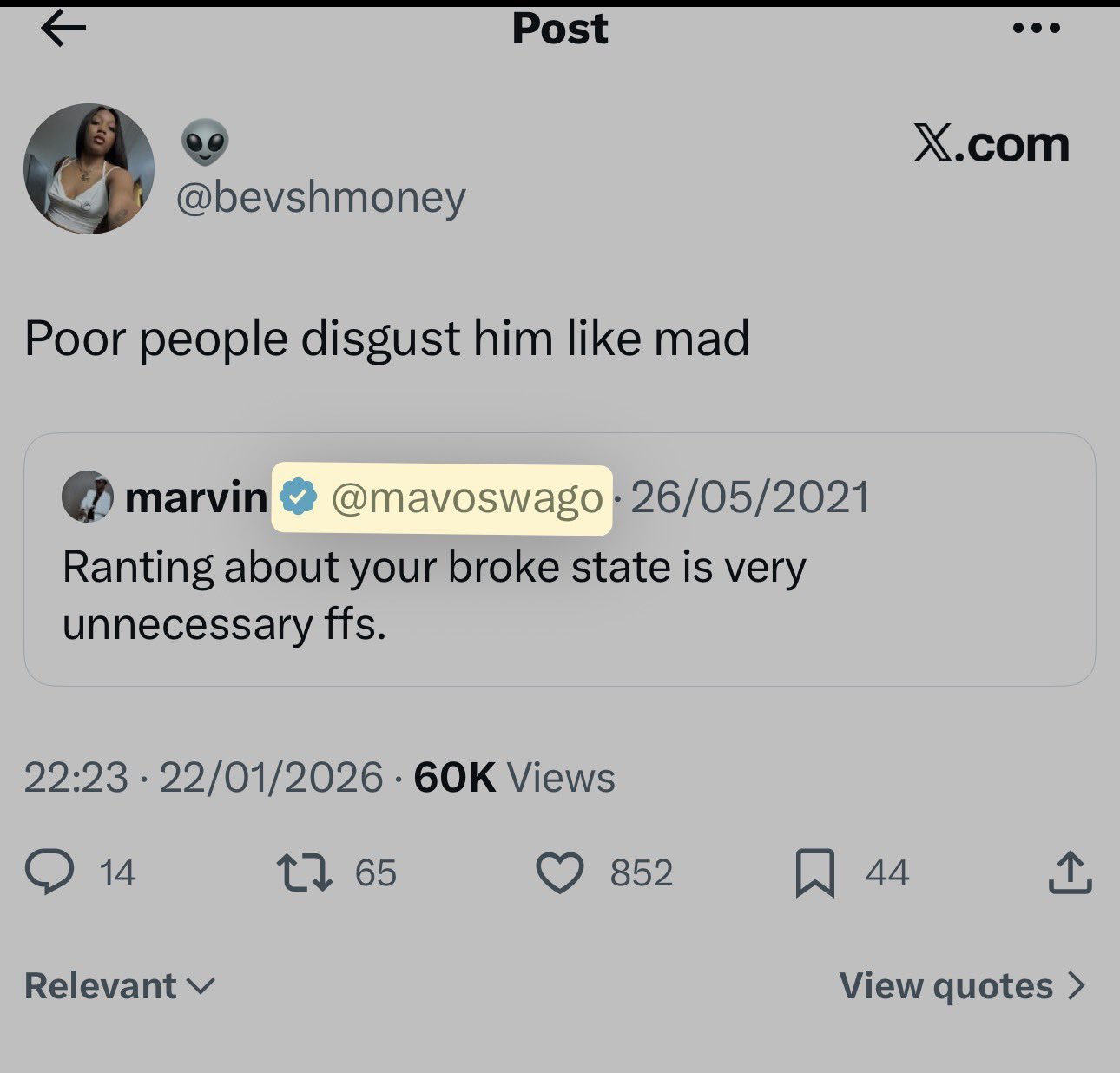
"No More Way for Poor People": What Mavo Actually Meant, and Why You're Arguing About the Wrong Thing
A 22-year-old from Ekpoma built a catchphrase that half the internet thinks is an insult. The other half quotes it back to themselves every morning. Both sides are missing the point.
Marvin Oseremen Ukanigbe — better known as Mavo — is a medical student at Afe Babalola University who spent his university years writing songs in his room and posting them to SoundCloud, building a following the slow way, one listener at a time. In 2025, a song called "Escaladizzy," recorded after a hotboxing session at the back of a friend's Escalade, went viral on TikTok, hit the UK Afrobeats chart, and put him in the company of Wizkid, Davido, and Ayra Starr on remix credits before the year was out.

But before Escaladizzy, there was a phrase. Five words that Mavo had been attaching to his name like a tagline long before the song that made him famous. Five words that, depending on who you asked, were either the defining ethos of a new generation or a classist declaration from a young man who had not yet thought carefully about what he was saying.
"No more way for poor people."
• • •
What He Actually Says It Means
The mischaracterization of this phrase is consistent and instructive. The people most offended by it tend to hear it as a statement about poverty — because if taken literally, Mavo is announcing that people without money do not deserve space or opportunity, that the world belongs to those who have already arrived.
Mavo himself, asked about it directly in an interview, gave a different answer: "It means if you're working hard but not seeing results, you're not working smart. Hard work alone isn't enough. You need to be smart about your grind." He added a second dimension: "I tell people, don't measure your worth in naira. Look at things from a global scale. Think in dollars. If you don't, you're boxing yourself in."
If we were to take his word for it, this is not a statement about poverty. It is a statement about mindset; specifically, a rejection of the kind of passive economic thinking that accepts a naira-denominated ceiling as a fixed reality. It is the kind of thing a certain generation of Nigerian young adults says to each other when someone is about to settle for less than they believe they are worth. It is motivational in the tradition of hustle culture: blunt, provocative, designed to jar rather than comfort.
But...
• • •
Why the Outrage Is Understandable Anyway
The critique of the phrase is not entirely baseless, and dismissing it would be too easy.
Nigeria is a country with a poverty rate that makes the word "poor" genuinely heavy. When a phrase that explicitly links poverty to worthlessness or exclusion enters mainstream youth culture, it carries the risk of normalizing a particular attitude toward economic precarity; one that locates failure in the individual's effort or mindset rather than in the structural conditions the individual is actually navigating. The version of hustle culture that shades into victim-blaming has a documented history of doing real harm, particularly in economies where systemic barriers are high and social mobility is genuinely constrained.
The context of Mavo's music matters here, too. He has described his sound as "luxury music": explicitly aspirational, oriented toward wealth and its symbols. "Escaladizzy" is named after a luxury SUV. The visual language of his brand is expensive. This is entirely his prerogative as an artist. But when the aesthetic is consistently oriented toward wealth accumulation as a value in itself, a phrase like "no more way for poor people" takes on additional meaning in that context, meaning that is not always within the artist's control.