You have spent years building your skills. You have hustled through internships, survived toxic bosses, and earned every line on your CV. You walk into the interview sharp, prepared, and ready. Then the hiring manager's eyes land on the small tattoo peeking out from your sleeve and the energy shifts. You never get a call back.
Or you are a 27-year-old product designer. You have a small tattoo of your grandmother's proverb written in Yoruba on your inner wrist. It means everything to you. You walk into a corporate interview and spend the entire meeting with your hand angled away from the panel. You get the job but you spend the next two years hiding a part of yourself that has nothing to do with your ability to do it.
Any of these sound familiar? You are probably not imagining it but the problem in that story is not your tattoo.

That post cracked open a conversation that has been simmering on this continent for years. Because here, the tattoo debate carries its own particular weight, shaped by culture, religion, colonial ideas of "professionalism," and a fast-growing young workforce that refuses to leave itself at the door.
First, let us talk about what "professional" actually means here
In many African cities, the image of a "professional" was inherited, not invented. The suit. The conservative haircut. The restrained appearance. Much of what we call "workplace standards" on this continent traces back to institutions built during colonial administration: banks, law firms, civil service, where conformity was the price of admission.
That inheritance still sits in many offices today. Walk into a legacy bank on a busy commercial street and you will still feel it. The unspoken dress code, the pressure to look a certain way to be taken seriously. It is not malicious. It is just old. And old does not mean right.
The rules about how a professional should look were written long before you were in the room. Nobody asked you, or anyone like you
Meanwhile, a different kind of office has been growing. The tech hubs. The creative agencies. The fintech startups. The media houses. These workplaces did not inherit those old templates; they built their own. And in those spaces, a tattoo on your forearm is about as controversial as a nose ring or locs. Which is to say: not very.
The numbers are telling a story
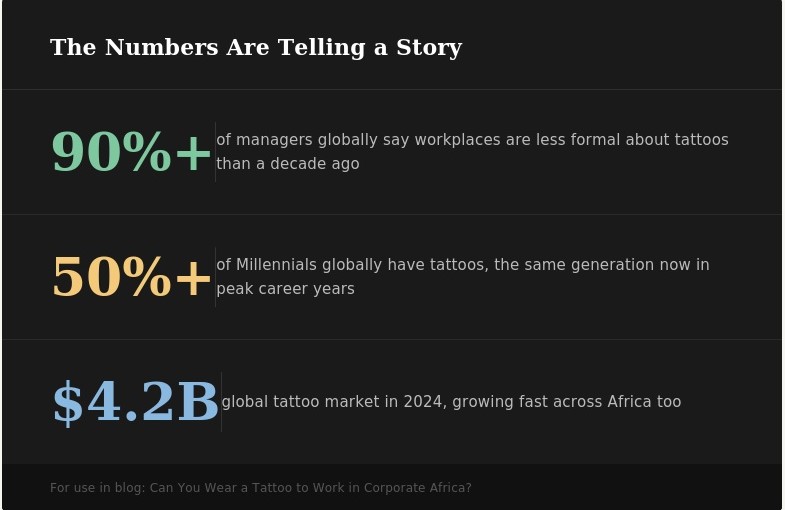
The tattoo market in the Middle East and Africa is expanding steadily, driven by younger, urban demographics embracing body art as identity...not rebellion. The professionals getting inked today are the same ones building startups, managing teams, and pitching investors. The idea that a tattoo signals anything other than personal expression is becoming harder and harder to defend.
Not every office is the same and that is your information to use
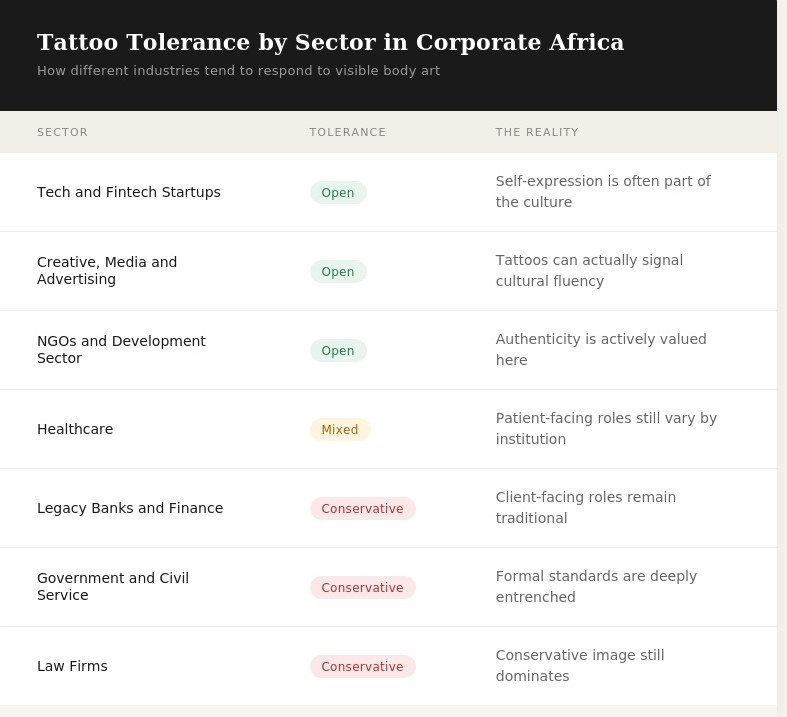
Let us be honest about the terrain, because context still matters. Here is how different sectors tend to land:
Read the room!
A sleeve tattoo at a tech startup on the island? Barely anyone blinks. At a traditional commercial bank or a law firm in a business district? Covering it temporarily is a practical decision, for now.
But here is where the thinking gets interesting.
The contrarian take: use their tattoo policy as a filter on them
A company that judges your tattoo before your CV is telling you something important about how they think. Listen.
An organisation that screens candidates based on visible body art is revealing something much deeper than a dress code preference. It is showing you that appearance ranks above ability. That conformity is the price of belonging. That the people making hiring decisions are relying on gut reactions instead of evidence.
Now ask yourself: if they are making that kind of snap judgment at the front door, what other snap judgments are happening inside? About your ideas in a meeting. About your promotion. About who gets the visible project and who stays in the back office.
Research backs this up. Companies that prioritise skills and cultural fit over appearance consistently access a larger, more talented pool of people and report stronger creativity and job satisfaction as a result. Those that cling to appearance-based gatekeeping are quietly narrowing their own options while calling it "standards."
Before your next interview
Research the company culture before you walk in. Team photos, their social media, how they talk about themselves. Do their people look expressive or uniform? That is your preview.
Placement matters. Neck, face, and hand tattoos still draw the most scrutiny everywhere. Wrist or arm tattoos in conservative sectors can be covered temporarily as a tactical choice, not a permanent one.
Treat their reaction as data. If a tattoo visibly changes how an interviewer engages with you, you have just learned something valuable about that organisation's culture. Use it.
Own it calmly if it comes up. "It is personal to me and has no bearing on my work" said with confidence carries far more weight than defensiveness. You do not owe an explanation, but composure is always powerful.
Know your non-negotiables. The longer you hide parts of yourself for a workplace, the more it costs you. Decide early what you are willing to navigate and what crosses a line.
The bigger question
This conversation is ultimately not about tattoos. It is about who gets to define what a professional looks like on this continent and whether that definition was ever really ours to begin with.